
Microsoft's new 10k-year data storage medium: glass
Source: Hacker News
Femtosecond lasers etch data into a very stable medium.
Note: Right now, silica hardware isn’t quite ready for commercialization.
Credit: Microsoft Research
Archival storage poses many challenges. We need media that is extremely dense, stable for centuries or more, and ideally doesn’t consume any energy when not being accessed. Numerous concepts have been explored—even DNA has been considered—but one of the simplest approaches is to cut the data into glass. Many types of glass are both physically and chemically stable, and it’s relatively easy to create microscopic features inside them.
There’s been a lot of preliminary work demonstrating different aspects of a glass‑based storage system. In the Wednesday issue of Nature, Microsoft Research announced Project Silica, a working demonstration that can read and write data into small glass slabs with a density of over a gigabit per cubic millimeter.
“Archival storage poses lots of challenges. We want media that is extremely dense and stable for centuries or more, and, ideally, doesn’t consume any energy when not being accessed.” – Microsoft Research
For more on DNA‑based storage, see the article on Ars Technica.
Writing on Glass
Glass is often thought of as fragile, prone to shattering, and (mistakenly) as a material that can flow over centuries. In reality, glass is a broad class of materials that can be engineered from many different chemical compositions. With the right formulation, researchers have created glass that is thermally and chemically stable, resistant to moisture ingress, temperature fluctuations, and electromagnetic interference. While careful handling is still required, such glass offers the stability needed for long‑term data storage.
Encoding Data
- How it works – Data are written by focusing ultrafast laser pulses inside the glass. The laser creates microscopic modifications (often called “nanogratings”) that encode binary information.
- Why it’s challenging – Traditional laser‑writing is slow because each feature must be formed individually.
- The breakthrough – Femtosecond lasers (pulses lasting ~10‑15 femtoseconds) can fire millions of pulses per second, dramatically reducing write time and allowing tight focusing for higher data density.
Reading Data
Several approaches can retrieve the information stored in glass:
- Optical readout – Similar to reading optical discs, a low‑power laser scans the glass and detects the refractive‑index changes.
- Other sensing methods – Any technique capable of resolving the sub‑micron features (e.g., confocal microscopy, interferometry) could be employed, though speed and cost vary.
From Theory to Practice: Project Silica
With the fundamental concepts in place, the next step was to integrate them into a functional system. Microsoft’s Project Silica tackled this by developing both the hardware and software needed to write, store, and retrieve data reliably. To mitigate risk, the team approached the problem from two complementary angles, ensuring redundancy and robustness in the final solution.
A Real‑World System
The difference between the two approaches comes down to how an individual unit of data (a voxel) is written to glass.
1. Birefringence‑based voxels
- Principle – Refraction depends on photon polarization.
- Process
- A first laser pulse creates an oval‑shaped void.
- A second, polarized pulse induces birefringence in that void.
- Encoding – The orientation of the oval defines the voxel’s identity. Because multiple orientations can be resolved, more than one bit can be stored per voxel.
2. Refractive‑index‑magnitude voxels
- Principle – Vary the magnitude of the refractive effect by changing the laser‑pulse energy.
- Encoding – Different energy levels produce distinct refractive states, allowing several bits to be stored in a single voxel.
Reading the Data
Reading is performed with a microscope that detects tiny differences in refractive index (i.e., phase‑contrast microscopy). The microscope’s depth of field limits how many voxel layers can be stacked in a piece of glass. During fabrication the layers are spaced far enough apart that only one layer is in focus at a time.
Special alignment symbols etched into the glass let the automated system position the lens over a chosen point, then step through the focal planes to capture images of each layer.
Decoding with AI
Microsoft trained a convolutional neural network (CNN) to interpret the microscope images. The network combines information from:
- Images that are exactly in focus for a given layer, and
- Images that are slightly out of focus (near‑focus).
Nearby voxels subtly affect a voxel’s appearance; the CNN learns to recognize these effects when supplied with enough training data.
Data Encoding Pipeline
- Raw bitstream →
- Error‑correction coding using a low‑density parity‑check (LDPC) code (the same code used in 5G networks).
- Symbol formation – Neighboring bits are grouped into symbols that exploit the multi‑bit capacity of each voxel.
- Write to glass – The symbol stream is written using the chosen voxel‑creation method.
Example Image
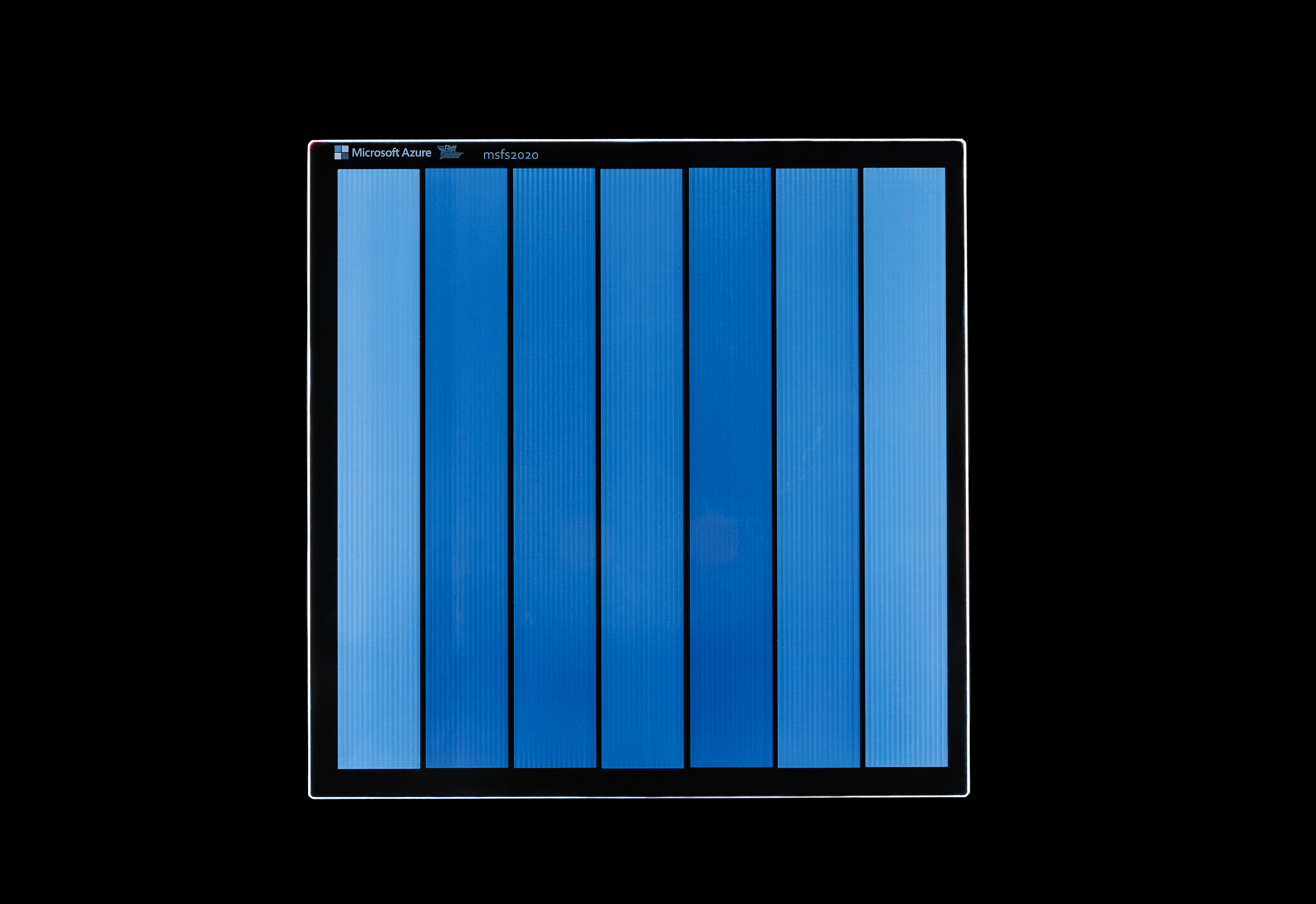
Figure: Map data from Microsoft Flight Simulator etched onto the Silica storage medium.
Credit: Microsoft Research
Performance
Writing remains a bottleneck, so Microsoft developed hardware that can write a single glass slab with four lasers simultaneously without generating excessive heat. This enables a write speed of 66 megabits per second, and the team believes adding up to a dozen additional lasers is feasible. A single slab can store up to 4.84 TB (dimensions 12 cm × 12 cm × 0.2 cm). At the current speed, fully writing a slab would take over 150 hours.
The “up‑to” aspect of the storage system depends on the density achievable with the two writing methods:
| Method | Data density | Hardware complexity | Material requirements |
|---|---|---|---|
| Birefringence‑based | Highest (more voxels per volume) | More optical hardware; works only with high‑quality glasses | High‑quality glass only |
| Alternative (simpler) | ~2 TB per slab | Simpler hardware | Works with any transparent material |
Borosilicate glass offers extreme stability; Microsoft’s accelerated‑aging experiments suggest the data would remain intact for over 10,000 years at room temperature. This led Microsoft to declare:
“Our results demonstrate that Silica could become the archival storage solution for the digital age.”
The claim is ambitious. For context, the Square Kilometre Array (SKA) telescope is expected to generate ≈ 700 PB of data per year, which would require > 140,000 glass slabs. Even with many additional lasers, keeping up would demand > 600 Silica machines operating in parallel. Nonetheless, Silica has several attractive features for archival storage:
- Zero energy consumption to preserve data.
- Rapid retrieval compared with alternatives such as DNA storage (which can take days).
- A futuristic aesthetic that feels straight out of science‑fiction (see the video at 5:02 min: https://youtu.be/V0bUd6KrQGg?t=302).
Reference – Nature, 2026. DOI: 10.1038/s41586-025-10042-w
(About DOIs: https://arstechnica.com/science/news/2010/03/dois-and-their-discontents-1/)
Correction: defined how etching is used here.
Author

John Timmer is Ars Technica’s science editor. He holds a B.A. in Biochemistry from Columbia University and a Ph.D. in Molecular and Cell Biology from the University of California, Berkeley. When he’s not at his keyboard, he can be found on a bicycle or hiking in scenic locations.