
Microsoft plans to improve Windows 11 driver quality in 2026
Source: Bleeping Computer
Introduction
Microsoft notes that drivers “sit at the heart of every Windows experience” and connect the OS to the silicon, components, and peripherals.
Before Windows 11 shipped, Microsoft frequently hosted WinHEC (Windows Hardware Engineering Conference), where developers and OEM partners worked on driver quality. The last WinHEC was held in 2018, after which Microsoft stopped hosting the events as it shifted focus toward its cloud business.
While the lack of an event doesn’t necessarily mean poor drivers, users have observed a decrease in quality, with monthly driver updates sometimes causing BSODs or artifacts in games.
Microsoft explains the initiative in a blog post:
“When drivers are high quality, customers experience reliable, secure, performant devices. When drivers fail, customers experience it as a device problem, regardless of where the root cause sits.”
Driver Quality Initiative (DQI)
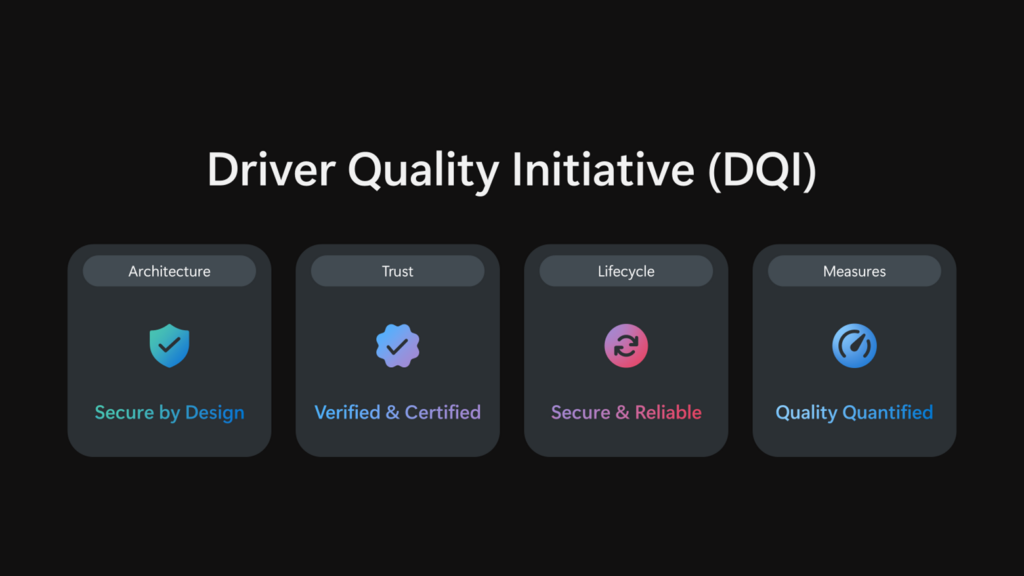
To address driver quality issues, Microsoft is introducing the Driver Quality Initiative, built on four pillars:
- Shift to safer drivers – Encourage third‑party drivers to move out of kernel mode into user‑mode drivers or Microsoft’s own class drivers.
- Stricter partner verification – Run more automated checks and update Windows Hardware Compatibility Program requirements.
- Improved Windows Update catalog hygiene – Remove outdated or low‑quality drivers and use better data to investigate issues.
- Holistic quality metrics – Evaluate stability, features, performance, battery impact, and heat, enabling partners to improve the real Windows experience.
Microsoft says DQI is a partnership and will work closely with partners such as AMD and Intel.
AMD says driver quality is a shared commitment
At WinHEC 2026, AMD emphasized that “higher‑quality drivers” are not the responsibility of a single company.
“It’s a shared commitment,” said David Harmon, Director, Software Engineering, AMD. “Through our close collaboration with Microsoft, AMD is focused on building a culture of joint accountability to ensure security, stability, and predictable performance for our customers at scale.”
Microsoft also discussed raising the bar on Windows 11 quality and delivering “exceptional device experiences” across media and display, camera, audio, connectivity, and peripherals.
DQI is based on learnings and infrastructure established through the Windows Resiliency Initiative (WRI).
It’s unclear when these driver changes will begin rolling out, but they are expected to be reflected gradually over the coming months as Microsoft continues major improvements to Windows.
Microsoft is reviving Windows 11
After months of criticism and mixed reception to Copilot, Microsoft is working to win back Windows fans.
During the FY26 Q3 earnings call, CEO Satya Nadella promised that the company is “doing the foundational work required to win back fans and strengthen engagement across Windows, Xbox, Bing, and Edge.” He highlighted recent work on Windows, including performance improvements for lower‑memory devices, a streamlined Windows Update experience, and a renewed focus on core features.
As part of Windows 11’s 2026 quality improvements, Microsoft is also:
- Restoring the movable taskbar (see the announcement on BleepingComputer).
- Adding a toggle to make the taskbar smaller and improving resize controls with a Windows 10‑like experience.
- Rumored additions such as a native Start menu, faster launch, reduced power consumption, a new performance mode, and more.