
Meta beware: Google could end up selling 2 million Android XR glasses this year
Source: Android Authority

TL;DR
- Analysts are bullish on Google’s upcoming Android XR glasses.
- Forecasts suggest Google could sell nearly 2 million units in 2026.
- That would surpass Meta’s first‑year estimated sales.
Background
Google’s first attempt at smart glasses was a commercial failure. To avoid repeating that pattern, the company is now taking a fashion‑first approach, partnering with eyewear brands for design while Samsung supplies the internal hardware. Google will focus on the overall hardware experience, especially the integration of its Gemini AI.
Forecast Overview
The newest Android XR smart glasses, showcased by Google and Samsung at I/O 2026, are expected to be a major hit. According to Smart Analytics Global (SAG), the Android XR lineup—including models designed by Warby Parker and Gentle Monster—could sell up to 2 million units in 2026.
- Meta’s timeline: Meta is projected to have taken until the end of 2024 to reach its first 2 million units, then accelerated to 7 million units in 2025.
- Google’s potential: If SAG’s forecast holds, Google could claim the second spot among AI‑powered smart‑glass sellers, trailing only Meta but overtaking brands such as Xiaomi, Huawei, and Rokid.
- Market share: Google’s glasses would represent roughly 20 % of total shipments.
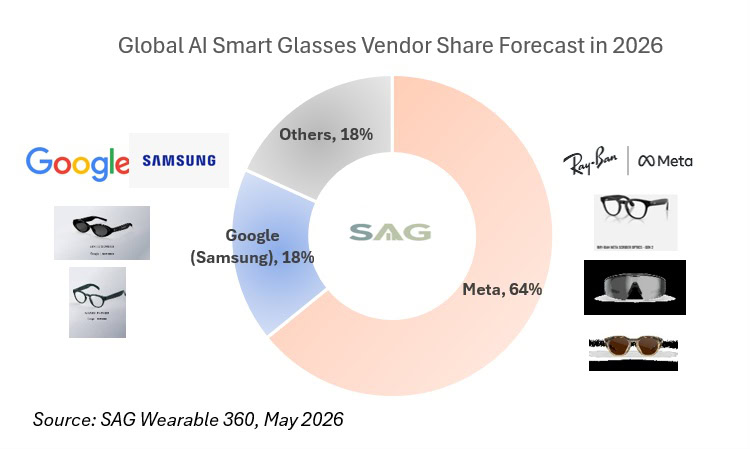
Smart Analytics Global forecast
Total Market Outlook
SAG projects that total smart‑glass shipments could reach 15 million units in 2026.
Audio‑Only vs. Display Glasses
- Audio‑only models are expected to dominate sales, accounting for about 91 % of total units in 2026. Their lighter weight and lower hardware requirements translate to a lower price point.
- Display‑enabled glasses (e.g., Google’s XR glasses with embedded lenses and a custom Android flavor) are likely to remain a smaller segment in terms of unit volume but could drive a larger share of revenue growth for manufacturers.
SAG’s earlier report (2024‑2030 forecast) indicates that audio will continue to be the primary interaction method for smart glasses in the near term, even as display models gain traction.
Implications
If the predictions materialize, Google’s entry could:
- Accelerate adoption of AI‑powered eyewear.
- Push other manufacturers to prioritize audio‑first designs or invest in higher‑margin display models.
- Strengthen Google’s position in the emerging XR ecosystem, especially with Gemini integration.