
Merging To Test Is Killing Your Microservices Velocity
Source: Dev.to
If you are a platform engineer or an engineering leader, look at your current development pipeline. Is everything treated equally?
To me, it seems that there is a glaring discrepancy in the way we treat different parts of the stack.
- Frontend – When a developer pushes code to a feature branch, tools like Vercel or Netlify immediately spin up a deploy preview. It is a unique URL, isolated from production, where they can click around and validate changes instantly.
- Database – When a database engineer needs to test a schema migration, modern platforms like Neon or PlanetScale allow them to branch the database. They get an isolated, copy‑on‑write clone of the production data to wreck and repair without affecting a single real user.
But what happens when a backend engineer pushes a change to one microservice in a mesh of 50?
Nothing.
There is a gaping hole in the middle of our cloud‑native stack. While frontend and data layers have embraced branch‑based development, the backend service layer is stuck in the stone age of shared environments.
This isn’t just an annoyance. It is the primary bottleneck preventing teams from truly shifting left.
The “Merge‑to‑Validate” Anti‑Pattern
In most distributed architectures, a developer working on a backend service cannot realistically run the entire platform on their laptop—it’s too heavy.
So they rely on unit tests and mocks1. But mocks are liars; they don’t catch contract drift between services or latency issues that only appear over the network.
To get real validation, the developer has to merge their branch to the main trunk so it can be deployed to a shared staging environment. This is where velocity goes to die.
| Symptom | Description |
|---|---|
| The queue | Developers wait in line to deploy to staging. |
| The block | If one developer breaks staging, everyone is blocked. |
| The noise | Tests fail, but is it your code, or did someone else deploy a bad config to the auth‑service five minutes ago? |
We have normalized this dysfunction. We treat staging as a fragile, sacred monolith. In an era where we want to deploy multiple times a day, merging to trunk just to see if your code works is backward—it’s like pouring concrete before you have checked the blueprints.
Image placeholder: Merge‑to‑Validate anti‑pattern
The Solution: Service Branching
We need to bring the Vercel and Neon experience to the Kubernetes backend. The goal is simple: every git branch should result in a testable, isolated environment.
The physics of microservices makes naïve duplication hard—cloning a cluster with 100+ services for every PR would be prohibitively expensive in cost and spin‑up time. The solution is isolation, not duplication.
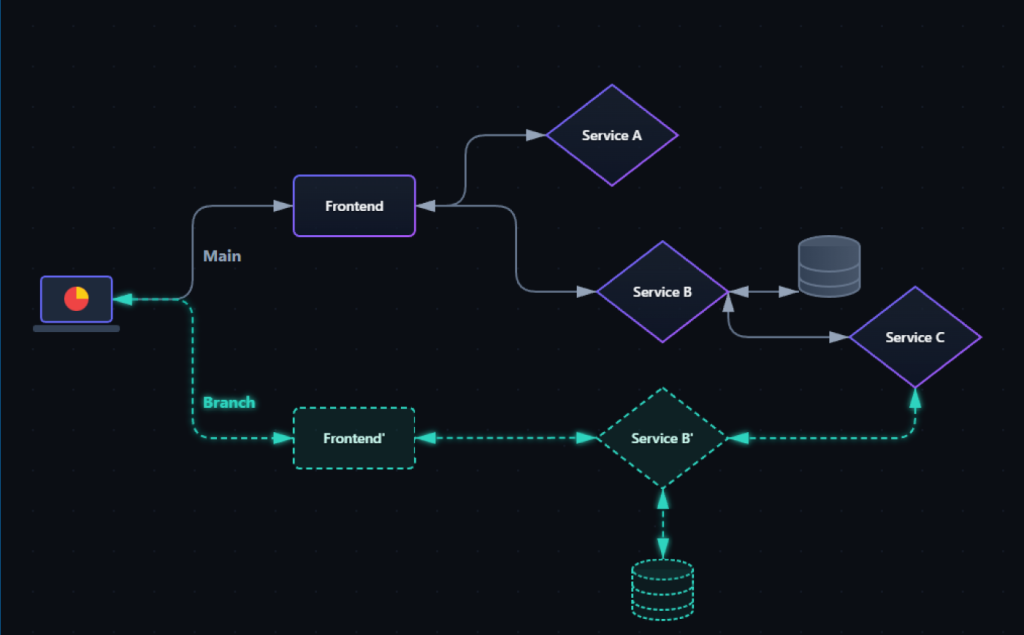
- Base environment – Your existing staging cluster runs the stable version of all services.
- Sandbox – When a developer pushes a change to a specific service, the platform spins up a lightweight sandbox containing only the modified service.
- Smart routing –
- Standard traffic flows through the stable baseline.
- Test traffic is intercepted and rerouted only to the sandboxed service.
- If the sandboxed service needs to call other services, it routes back into the stable baseline.
This gives the developer the experience of a full, dedicated environment with a fraction of the infrastructure footprint.
Image placeholder: Service sandbox diagram
The New Mental Model: Git = Environment
For this to work at scale, platform engineers need to provide a clean mental model that maps source code directly to infrastructure.
| Git reference | Corresponding environment |
|---|---|
| Trunk (main) | Baseline environment (staging). The source of truth where all services interact as expected. |
| Feature branch (feat‑xyz) | Ephemeral sandbox environment. Lives only as long as the PR is open and contains only the delta of the services that changed in that branch. |
When a developer opens a PR, they don’t need to think about clusters or namespaces—they just get a dedicated playground that mirrors their branch perfectly.
The Holy Grail: The Full Virtual Stack
When you combine service branching with existing tools for frontend and database branching, you unlock something powerful: a full virtual stack per branch.
Imagine a workflow where a developer creates a branch, and magically a complete, isolated environment materializes. To the developer, it feels like the entire production system is running just for their changes—without the cost, latency, or risk of a shared staging environment.
References
- Why mocks fail real‑environment testing for microservices –
- The struggle to test microservices before merging –
- Sandbox testing: the devex game‑changer for microservices –
# Feature Branch Environments
Developers feel like they have their own private copy of the entire company’s infrastructure.
This includes the frontend, backend services, and database schemas—all aligned to their specific code changes.
- **End‑to‑end testing:** Run integration tests on the branch before merging.
- **Instant demos:** Hand a URL to a product manager to showcase the feature.
- **Safe migrations:** Validate complex database migrations without affecting anyone else.
It’s a dedicated reality for the feature—created instantly and destroyed just as quickly.
[](https://dev-to-uploads.s3.amazonaws.com/uploads/articles/9llrwcfgh7asl0wvsamu.png)Why This Matters: Speed and Quality at Scale
This model shifts the paradigm from serial blocking to massive parallelism.
- Remove the bottleneck: Large engineering teams no longer have to queue for staging. Ten, fifty, or a hundred developers and agents can test simultaneously without stepping on each other’s toes.
- True shift‑left: Integration testing happens during development, not after the merge. You catch the bug when you write it, not three days later when the staging build fails.
- More quality, faster: When testing is easy and isolated, people do more of it. We stop fearing deployments and start treating them as routine.
The result is a software delivery pipeline that is both significantly faster and more stable.
Closing the Gap
The technology to do this exists. The patterns are proven. It’s time for platform teams to stop managing static environments and start managing dynamic, ephemeral workflows.
If you are looking to implement this service‑branching layer to complete your testing strategy, this is exactly what Signadot was built for.
Signadot provides the orchestration layer that brings request‑based isolation to Kubernetes.
Stop merging to test. Start branching to validate.
Footnotes
-
Mocks are useful for unit testing but cannot replace integration tests that run against real services. They often hide contract violations and performance regressions that only surface in a live environment. ↩