
Making Wolfram Tech Available as a Foundation Tool for LLM Systems
Source: Hacker News
Foundation Models Need a Foundation Tool
LLMs don’t—and can’t—do everything. What they do is very impressive and useful: it’s broad, often human‑like, and powerful. But it isn’t precise, and it isn’t meant for deep computation.
Why a Complementary Tool?
To supplement LLM foundation models we need a foundation tool—a broad, general system that does what LLMs can’t: provide deep computation and precise knowledge.
Wolfram Language: The Tool We’ve Been Building for 40 Years
My goal with the Wolfram Language has always been to make as much of the world as possible computable. By unifying algorithms, methods, and data, it enables precise computation whenever it’s feasible. The effort has been massive, but it has also been hugely successful—fueling countless discoveries and inventions (including my own) across a remarkable range of scientific, technological, and other domains.
- Broad and General – The language offers a single, coherent environment for a vast array of computations.
- Precise Knowledge – It contains curated data and algorithms that give exact results.
- Unified Connectivity – It serves as a hub for linking to external systems and services (see compatibility & connectivity).
LLMs + Wolfram Language = A Powerful Combination
Now it’s not only humans who can exploit this technology; AIs—especially large language models—can too.
- LLM foundation models are already powerful.
- LLM + Wolfram Language become even more powerful, because the language supplies the precise computation and knowledge that LLMs lack.
The convergence is timely: decades of building a broad, general computational platform align perfectly with the breadth of modern LLMs. While LLMs can call specialized tools for niche tasks, the Wolfram Language is a general‑purpose tool that brings the full strength of precise computation to any problem.
A Medium for Computational Thinking
From the start, the Wolfram Language was designed not only for computation but also for representing and reasoning about concepts computationally (read more). I originally imagined this medium for human users, but it turns out AIs benefit from the same capabilities—providing them a perfect substrate for “thinking” and “reasoning” in a computational way.
The Path Forward
Because the Wolfram Language unifies algorithms, data, and connectivity, it can serve as a standard, general interface for LLMs to access Wolfram technology. This creates a robust bridge between LLM foundation models and the foundation tool that is the Wolfram Language, opening new possibilities for AI‑augmented computation and discovery.
The Tech to Use Our Foundation Tool Is Here
On January 9, 2023, just weeks after ChatGPT burst onto the scene, I posted a piece entitled “Wolfram|Alpha as the Way to Bring Computational Knowledge Superpowers to ChatGPT”.
Two months later we released the first Wolfram plugin for ChatGPT (and in between I wrote what quickly became a rather popular little book entitled What Is ChatGPT Doing … and Why Does It Work?). The plugin was a modest but good start, but at the time LLMs and their surrounding ecosystem weren’t yet ready for the bigger story.
Early Questions
- Do LLMs even need tools?
- Will LLMs magically learn deep computation and guarantee precise, reliable results?
- If tools are needed, how should the process be engineered and what deployment model should be used?
What We’ve Learned
Three years later, many of those questions have clearer answers:
- The core capabilities of LLMs are better understood (even though a lot remains scientifically unknown).
- For the modalities LLMs currently address, most practical value growth will come from how they are harnessed and connected.
- This underscores the broad importance of giving LLMs access to the foundation tool that our technology provides.
A New, Streamlined Path
There are now streamlined ways to integrate our foundation tool with LLMs—using emerging protocols, methods, and new technology we’ve developed. The tighter the integration between foundation models and our tool, the more powerful the combination.
Computation‑Augmented Generation (CAG)
- Concept: Inject real‑time capabilities from our foundation tool into the stream of content that LLMs generate.
- Contrast with RAG: Traditional retrieval‑augmented generation (RAG) injects content retrieved from existing documents. CAG extends this idea infinitely—generating on‑the‑fly computational content to feed an LLM.
- Implementation: Internally CAG is a sophisticated technology that took us a long time to perfect, but we have packaged it for easy integration into existing LLM‑related systems and workflows.
What This Means for You
- Immediate applicability: Any LLM system—or foundation model—can now access our Foundation Tool.
- Super‑charged capabilities: LLMs can supplement their output with the precise, deep computation and knowledge that only our tool can provide.
We are launching CAG today, opening the door for developers and organizations to build the next generation of AI‑augmented applications.
The Practicalities
Today we’re launching three primary methods for accessing our Foundation Tool, all based on computation‑augmented generation (CAG) and leveraging our extensive software‑engineering technology stack.
- Method 1 – [Link to method details]
- Method 2 – [Link to method details]
- Method 3 – [Link to method details]
For more information, see the official announcement:
Foundation Tool – Three Primary Methods
MCP Service
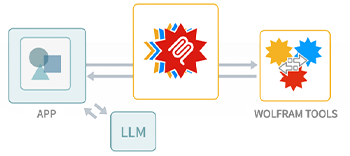
Immediately call our Foundation Tool from within any MCP‑compatible LLM‑based system. Most consumer LLM‑based systems now support MCP, making this extremely easy to set up.
- Main offering: a web API
- Alternative: a version that can run on a local Wolfram Engine
Agent One API
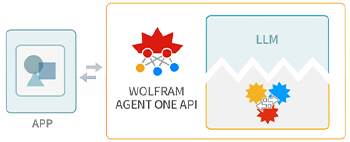
A one‑stop‑shop “universal agent” that combines an LLM foundation model with Wolfram’s Foundation Tool. It can be used as a drop‑in replacement for traditional LLM APIs.
CAG Component APIs
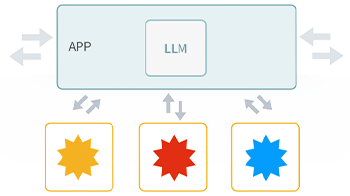
Direct, fine‑grained access to Wolfram technology for LLM systems, supporting optimized, custom integration into LLM deployments of any scale. All Wolfram technology is available both as a hosted service and for on‑premise installation.
-
For further information on access and integration options, contact our Partnerships group ».