
Jony Ive Designed Ferrari Luce EV Interior
Source: Hacker News
Introduction
What you’re looking at here is arguably the most consequential car interior ever. It sits inside the Ferrari Luce – now we know the name – and its unveiling is phase two of the three‑step launch process for the Italian legend’s first all‑electric car.
The significance stems from the involvement of Sir Jony Ive, the former chief design officer at Apple, and his design collective LoveFrom. Together with longtime collaborator Marc Newson, they have re‑imagined the interior and user interface for Ferrari’s electric flagship.
Design Leadership
Apple recently abandoned its long‑gestating plans to enter automotive, freeing Ive—who left Apple in 2019 to co‑found LoveFrom—to explore new territories. A long‑time friend of Ferrari executive chairman John Elkann, Ive and Newson were drawn to the prospect of designing an electric Ferrari.
Five years later, the Luce’s interior is revealed, showcasing a blend of Apple‑inspired minimalism and Ferrari’s performance heritage. The design philosophy emphasizes a physical, engaging interface that merges analogue and digital elements.
“We wanted to explore an interface that was physical and engaging,” Ive tells TopGear.com on a personal guided tour during the reveal near LoveFrom’s San Francisco HQ, “and to take the most powerful parts of an analogue display and combine them with a digital display… The binnacle and steering wheel are intimately connected. This is about driving, and everything else augments that experience.”
Interior Design Details
Ergonomics and HMI
- Main binnacle: three‑spoke wheel, self‑contained central infotainment display, aluminium substrate with four air vents.
- Physical controls: all controls are mechanical, stressing durability and tactile feedback.
- Instrument binnacle: 12.86‑in sculptural display with rounded edges, no visible plastic on the wheel‑column surround.
Materials Excellence
- Predominantly anodised aluminium, machined from solid billets using 3‑ or 5‑axis CNC milling.
- Ultra‑thin, surface‑hexagonal‑cell microstructure for resilience and visual appeal.
- Security screws echo Apple’s aesthetic (similar to Pentalobe screws).
Wheel and Controls
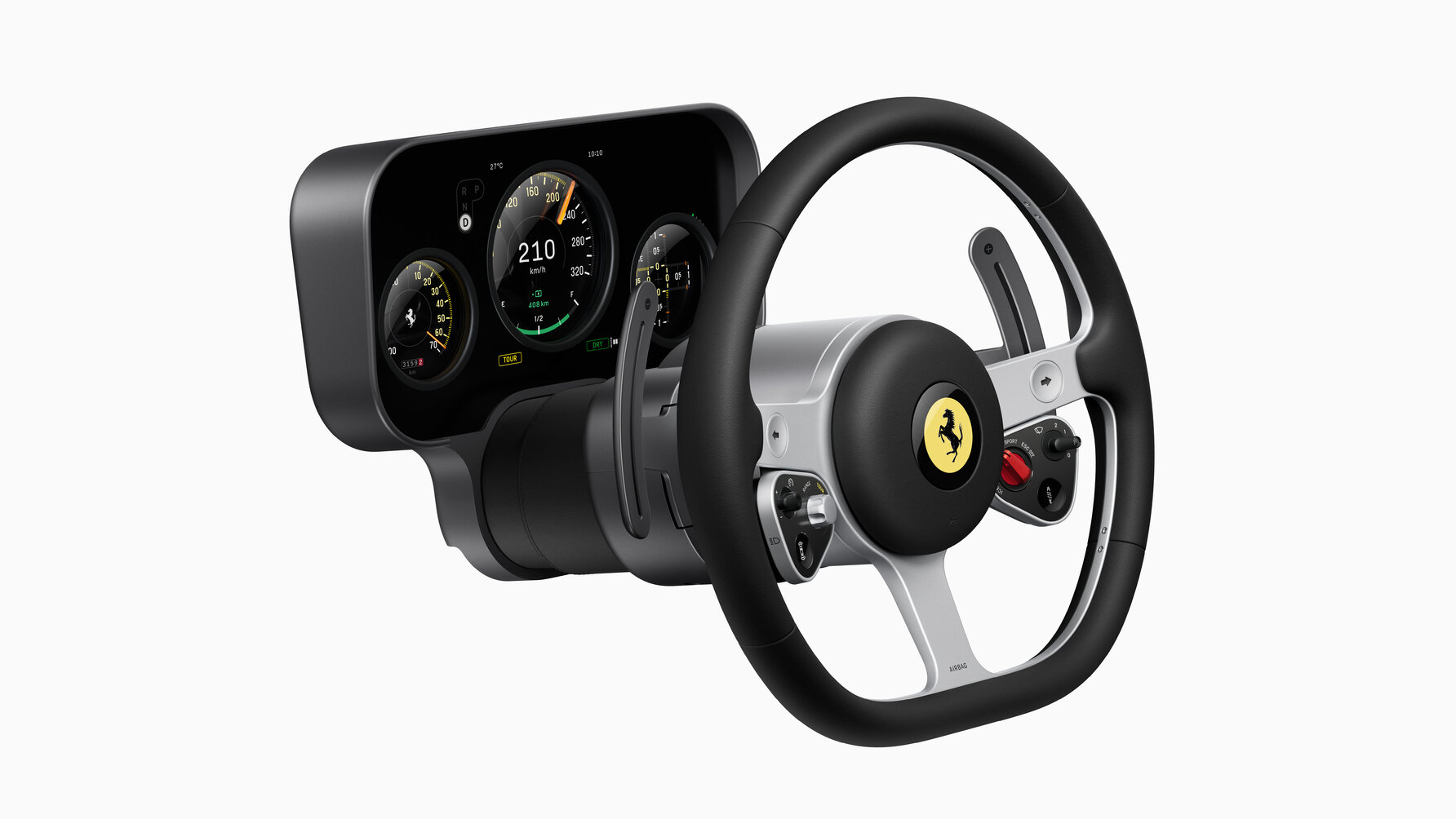
- Wheel made from a 100 % recycled aluminium alloy, comprising 19 CNC‑machined parts.
- Two pods beneath the main spars: right pod adjusts powertrain mode (Range, Tour, Performance); left pod houses a reimagined manettino for chassis configuration, damping, and wiper control.
- Paddle shifters: right for Torque Shift Engagement, left for regenerative braking.
“Everything is founded on being functional. It’s not styled, it’s not garnish, because that’s a distraction and it doesn’t last well,” Ive insists.
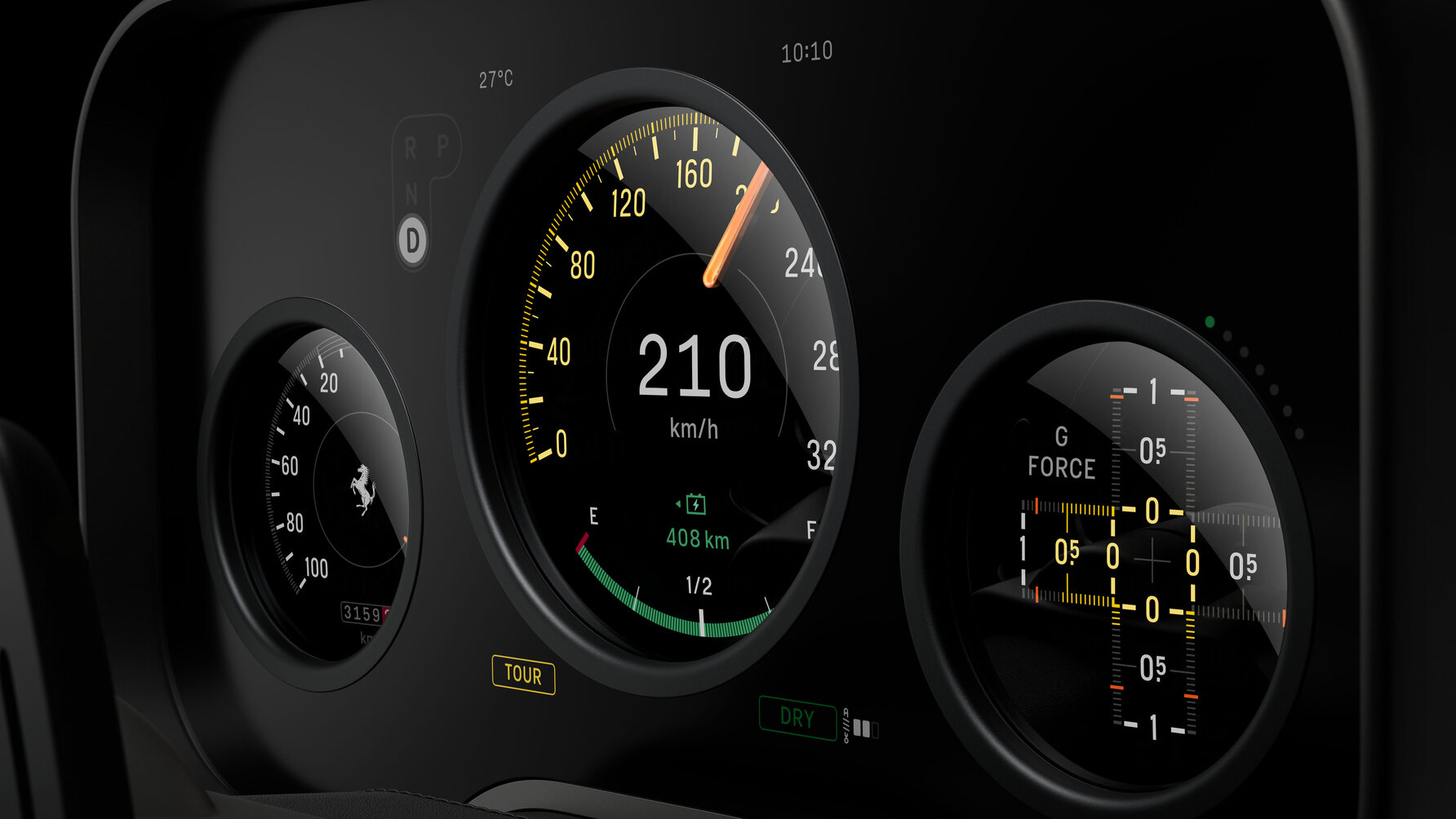
Avionic‑Inspired Dials
- Three principal dials, central one delivering key information.
- Developed with Samsung: slim‑line overlapping OLED panels with independent pixel control, delivering perfect black levels and Parallax effect.
- Physical anodised‑aluminium needle, graphics inspired by classic Ferraris (Veglia and Jaeger instruments).
Lighting and Displays
- Interior illuminated by 15 LEDs to reduce cognitive load.
- 10.12‑in central control screen mounted on a ball‑and‑socket joint for driver or passenger pivoting; includes a palm rest.
- Physical climate‑control switches echo Ive’s love for tactile, functional interfaces.
“We treated every single element as if it was a camera or a watch,” Ive continues. “Nothing was vague or hand‑wavy… Over time your respect and affection actually grows.”
Additional Screen Features
- Top‑right multigraph shows clock, chronograph, compass, and launch‑control info.
- Proprietary movement with three independent motors and multiple gear sets.
Shifter & Centre Console
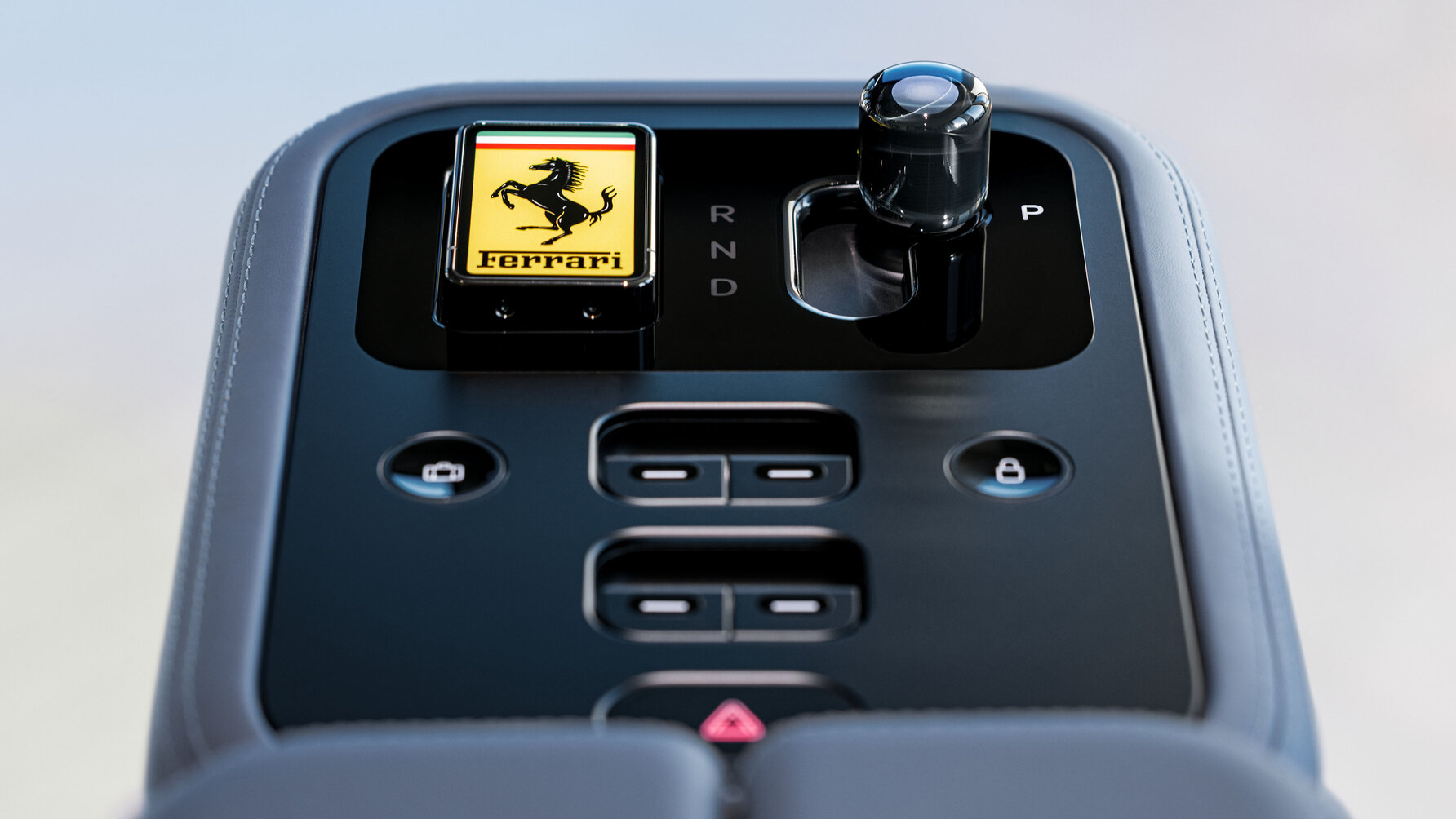
- Glass panel utilizes Corning’s Fusion5® technology (laser‑drilled 13,000 tiny holes, ink‑filled, semi‑matte finish).
- Key dock changes from yellow to black via e‑ink when the key is placed.
- The shifter and centre console receive equal attention, blending functional design with high‑tech materials.
“In the Sixties and early Seventies there was an opportunity to translate new design codes,” Ferrari’s chief design officer Flavio Manzoni says. “We wanted to create cross‑fertilisation between two different fields… The approach was very human‑centred.”
A Generational Car
Ferrari’s first electric model is positioned as more than just an Elettrica; it aims to be a timeless, high‑performance vehicle that bridges automotive heritage with consumer‑electronics durability.
“It’s been assumed that it would be called Elettrica, but it was felt that Elettrica would be a limitation,” says John Elkann. “What we have done here is not only very, very difficult to conceptualise, it’s difficult to do. That will make the Ferrari Luce unique.”
“The older I’ve got, the more I’ve been up to, I’ve felt a real shift in what I care about,” Jony Ive concludes. “Who I work with has become much more important than what I work on. One of the characteristics of this project is a sincere and authentic friendship. We actually really like each other.”