
Interop 2025: A year of convergence
Source: WebKit Blog
Overview
Feb 6, 2026
by Nicole Sullivan
Interop 2025 has come to a close, and the results speak for themselves. Now in its fourth year, the Interop project brings together Apple, Bocoup, Google, Igalia, Microsoft, and Mozilla to identify the areas of the web platform where interoperability matters most to you as a web developer — and then do the work to get there. This year was the most ambitious yet: the group selected 19 focus areas and 5 investigation areas spanning CSS, JavaScript, Web APIs, and performance.
- At the start of 2025, only 29 % of the selected tests passed across all browsers.
- By the end of the year, the Interop score reached a 97 % pass rate — and all four experimental browsers (Chrome Canary, Edge Dev, Firefox Nightly, and Safari Technology Preview) reached 99 %.
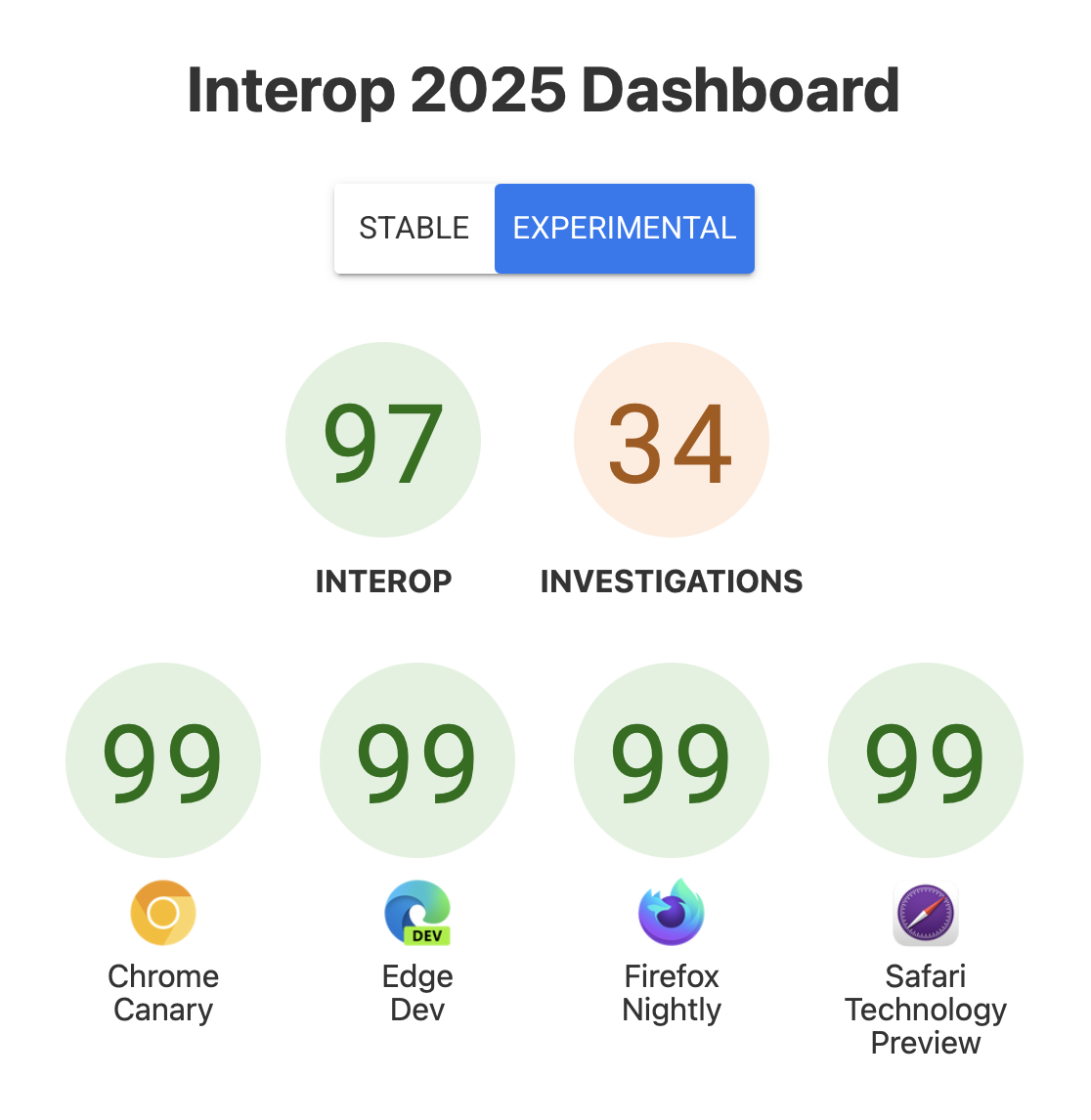
Each year, the Interop project chooses its focus areas through a collaborative process with proposals, research into what web developers need, and debates about priorities. For Interop 2025, our team advocated for including focus areas that we knew would require significant engineering investment from WebKit — because we knew those areas would make a real difference to you. The results show that commitment paid off. Safari made the largest jump of any browser this year, climbing from 43 % to 99 %.
As always, this year’s focus areas were chosen based on developer feedback, including results from the State of CSS survey, and we’re proud of how much ground we covered. The 19 focus areas touched nearly every corner of the platform.
CSS & UI
- Anchor Positioning
- View Transitions
@scopebackdrop-filtertext-decoration- Writing modes
- Layout (Flexbox & Grid)
<details>element
APIs & Platform Features
Health & Compatibility
Investigation Areas
- Accessibility testing
- Gamepad API testing
- Mobile testing
- Privacy testing
- WebVTT
Highlights: three especially meaningful focus areas
Anchor positioning
Position popovers, tooltips, and menus relative to any element purely in CSS — no JavaScript positioning libraries required. It’s one of the most requested CSS features of the last several years, and it now works interoperably across all browsers.Same‑document View Transitions
Enable smooth, animated transitions between UI states natively in the browser, along with the newview-transition-classCSS property for flexible styling. Support shipped in fall 2024 in Safari 18.0 and Safari 18.2. Web developers are excited about View Transitions, and the extra attention on interoperability means it’s ready for you to use.Navigation API – a modern replacement for
history.pushState()– gives single‑page applications proper navigation handling with interception, traversal, and entries. Support shipped in Safari 26.2, and we’re glad to see it arrive interoperably from the start.
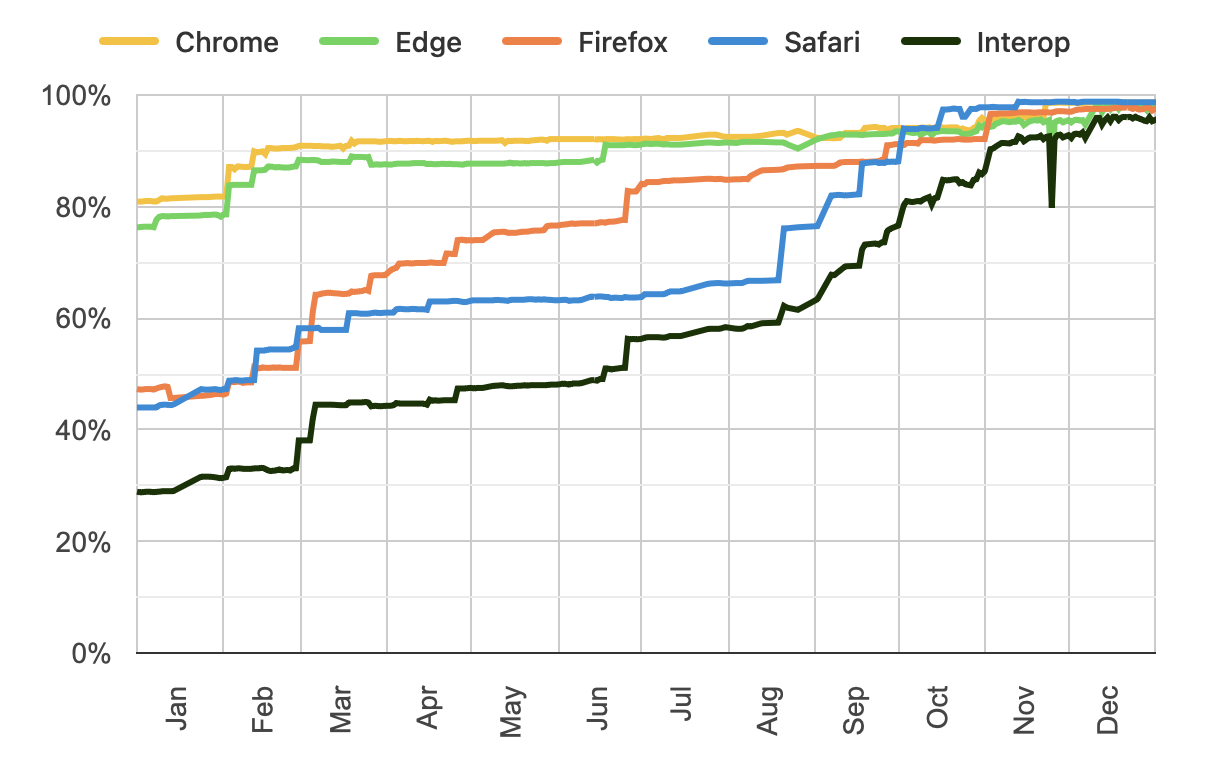
The Interop project tells the story of the year: every browser engine invested heavily, and the lines converge at the top. That convergence is what makes the Interop project so valuable — the shared progress that means you can write code once and trust that it works everywhere.

We want to thank our colleagues across the industry who made this possible. Interoperability is one of the foundational strengths of the web, and we remain committed to this collaboration. You can explore the full results, including scores for each individual focus area, on the [Interop 2025 dashboard](https://wpt.fyi/interop-2025).