
I Built QualityHub: AI-Powered Quality Intelligence for Your Releases
Source: Dev.to
🎯 The Problem
As a developer at Renault, I faced this question every day:
“Can we ship this release to production?”
We had test results, coverage metrics, SonarQube reports… but no single source of truth to answer this simple question.
So I built QualityHub – an AI‑powered platform that analyzes your quality metrics and gives you instant go/no‑go decisions.
🚀 What is QualityHub?
QualityHub is an open‑source quality intelligence platform that:
- 📊 Aggregates test results from any framework (Jest, JUnit, JaCoCo…)
- 🤖 Analyzes quality metrics with AI
- ✅ Decides if you can ship to production
- 📈 Tracks trends over time in a beautiful dashboard
The Stack
| Component | Technology |
|---|---|
| Backend | TypeScript, Express, PostgreSQL, Redis |
| Frontend | Next.js 14, Tailwind CSS |
| CLI | TypeScript with parsers for Jest, JaCoCo, JUnit |
| Deployment | Docker Compose (self‑hostable) |
| License | MIT |
💡 How It Works
1. Universal Format – qa-result.json
Instead of forcing you to use specific tools, QualityHub uses an open standard format:
{
  "version": "1.0.0",
  "project": {
    "name": "my-app",
    "version": "2.3.1",
    "commit": "a3f4d2c",
    "branch": "main",
    "timestamp": "2026-01-31T14:30:00Z"
  },
  "quality": {
    "tests": {
      "total": 1247,
      "passed": 1245,
      "failed": 2,
      "skipped": 0,
      "duration_ms": 45230,
      "flaky_tests": ["UserAuthTest.testTimeout"]
    },
    "coverage": {
      "lines": 87.3,
      "branches": 82.1,
      "functions": 91.2
    }
  }
}
This format works with any test framework.
2. CLI Parsers
The CLI automatically converts your test results:
# Jest (JavaScript/TypeScript)
qualityhub parse jest ./coverage

# JaCoCo (Java)
qualityhub parse jacoco ./target/site/jacoco/jacoco.xml

# JUnit (Java/Kotlin/Python)
qualityhub parse junit ./build/test-results/test
3. Risk Analysis Engine
The backend analyzes your results and calculates a Risk Score (0‑100).
Risk factors analyzed
- Test pass rate
- Code coverage (lines, branches, functions)
- Flaky tests
- Coverage trends
- Code‑quality metrics (if available)
Sample output
{
  "risk_score": 85,
  "status": "SAFE",
  "decision": "PROCEED",
  "reasoning": "Test pass rate: 99.8%. Coverage: 87.3%. No critical issues.",
  "recommendations": []
}
4. Beautiful Dashboard
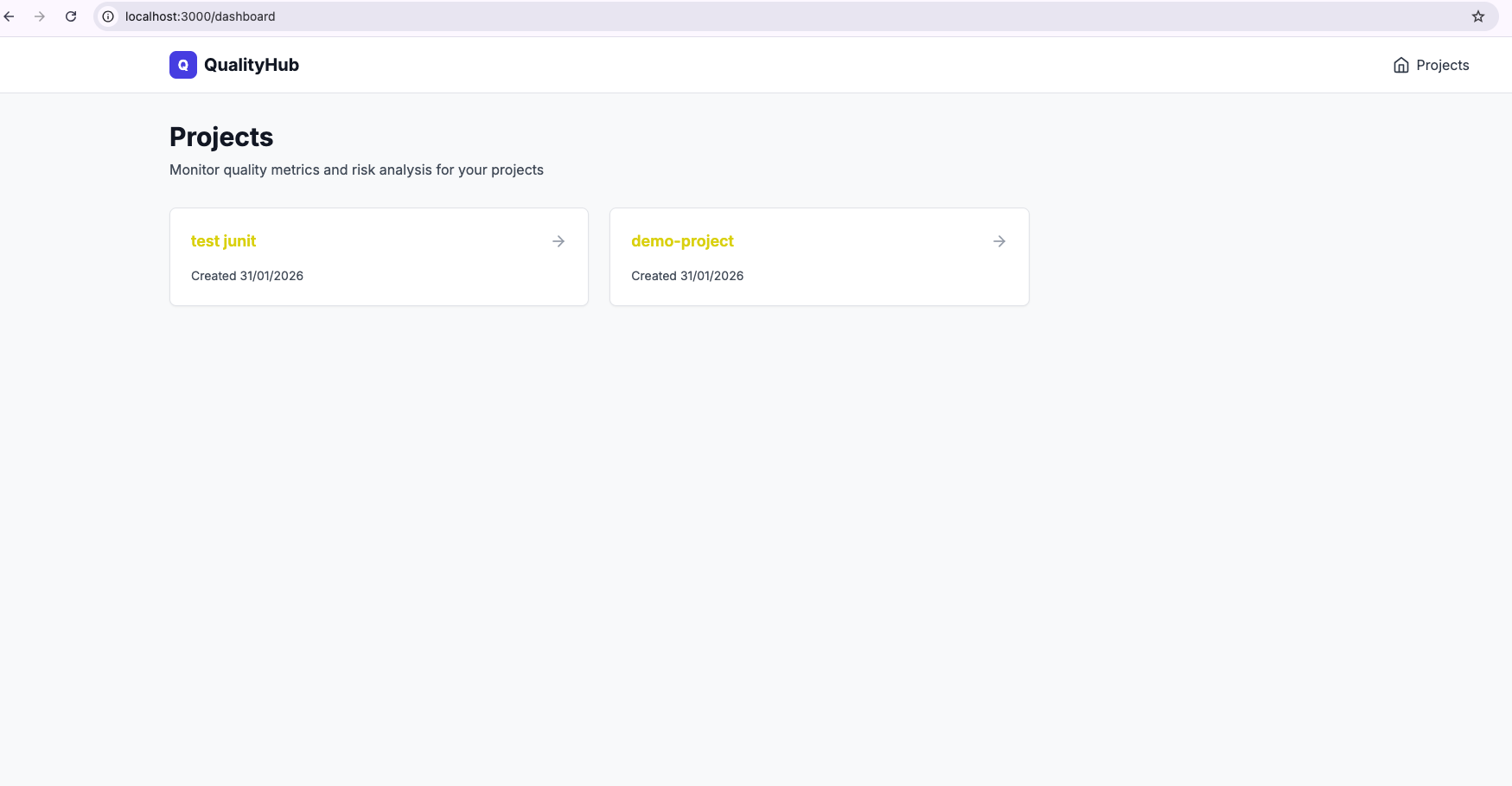
Track metrics over time, see trends, and make informed decisions.
🔧 Quick Start
Self‑Hosted (5 minutes)
# Clone repo
git clone https://github.com/ybentlili/qualityhub.git
cd qualityhub

# Start everything with Docker
docker-compose up -d

# ✅ Backend: http://localhost:8080
# ✅ Frontend: http://localhost:3000
Use the CLI
# Install
npm install -g qualityhub-cli

# Initialize
qualityhub init

# Parse your test results
qualityhub parse jest ./coverage

# Push to QualityHub
qualityhub push qa-result.json
Done! Your metrics appear in the dashboard instantly.
🎨 Why I Built This
The Pain Points
- Fragmented tools – Jest for tests, JaCoCo for coverage, SonarQube for quality… each with its own UI and format.
- No single answer – “Can we ship?” required checking several tools and making a gut decision.
- No history – Hard to track quality trends over time.
- Manual process – No automation, no CI/CD integration.
The Solution
QualityHub aggregates everything into one dashboard and uses AI to make the decision for you.
🏗️ Architecture
┌─────────────┐
│     CLI     │ ← Parse test results
└──────┬──────┘
       │ POST /api/v1/results
       ↓
┌─────────────────────────────┐
│     Backend (API)           │
│  • Express + TypeScript     │
│  • PostgreSQL + Redis       │
│  • Risk Analysis Engine     │
└──────────────┬──────────────┘
               │
               ↓
┌─────────────────────────────┐
│   Frontend (Dashboard)       │
│  • Next.js 14                │
│  • Real‑time metrics         │
└─────────────────────────────┘
📊 Technical Deep Dive
1. The Parser Architecture
Each parser extends a base class:
export abstract class BaseParser {
  abstract parse(filePath: string): Promise;

  protected buildBaseResult(adapterName: string) {
    return {
      version: '1.0.0',
      project: {
        name: this.projectInfo.name,
        commit: process.env.GIT_COMMIT || 'unknown',
        // Auto‑detect CI/CD environment
        timestamp: new Date().toISOString(),
      },
      metadata: {
        ci_provider: this.detectCIProvider(),
        adapters: [adapterName],
      },
    };
  }
}
This makes adding new parsers trivial. Want pytest support? Extend BaseParser and implement parse().
2. Risk Scoring Algorithm (MVP)
The current version uses rule‑based scoring:
let score = 100;

// Test failures
if (tests.failed > 0) {
  score -= tests.failed * 5;
}

// Coverage thresholds
if (coverage.lines < 80) {
  score -= (80 - coverage.lines) * 0.5;
}
if (coverage.branches < 70) {
  score -= (70 - coverage.branches) * 0.5;
}
if (coverage.functions < 75) {
  score -= (75 - coverage.functions) * 0.5;
}

// Flaky tests
if (flakyTests.length > 0) {
  score -= flakyTests.length * 3;
}

// Ensure 0‑100 range
score = Math.max(0, Math.min(100, score));Future: Replace with an AI‑powered model that learns from historical releases.
3. red analysis (Claude API) for contextual insights
4. Database Schema
Simple and efficient:
CREATE TABLE projects (
    id UUID PRIMARY KEY,
    name VARCHAR(255) UNIQUE NOT NULL,
    created_at TIMESTAMP DEFAULT CURRENT_TIMESTAMP
);

CREATE TABLE qa_results (
    id UUID PRIMARY KEY,
    project_id UUID REFERENCES projects(id),
    version VARCHAR(50),
    commit VARCHAR(255),
    branch VARCHAR(255),
    timestamp TIMESTAMP,
    metrics JSONB,          -- Flexible JSON storage
    created_at TIMESTAMP DEFAULT CURRENT_TIMESTAMP
);

CREATE TABLE risk_analyses (
    id UUID PRIMARY KEY,
    qa_result_id UUID REFERENCES qa_results(id),
    risk_score INTEGER,
    status VARCHAR(50),
    reasoning TEXT,
    risks JSONB,
    recommendations JSONB,
    decision VARCHAR(50)
);
JSONB allows flexible metric storage without schema migrations.
🚀 What’s Next?
v1.1 (Planned)
- 🤖 AI‑Powered Analysis with Claude API
- 📊 Trend Detection (coverage dropping over time)
- 🔔 Slack/Email Notifications
- 🔌 GitHub App (comments on PRs)
v1.2 (Future)
- 📈 Advanced Analytics (benchmarking, predictions)
- 🔐 SSO & RBAC for enterprise
- 🌍 Multi‑language support
- 🎨 Custom dashboards
💡 Lessons Learned
Open Standards Win
Makingqa-result.jsonan open standard was key. Now anyone can build parsers or integrations.Developer Experience Matters
The CLI must be dead simple:qualityhub parse jest ./coverage # Just worksNo config files, no setup—just works.
Self‑Hosting is a Feature
Many companies can’t send their metrics to external SaaS. Docker Compose makes self‑hosting trivial.
🤝 Contributing
QualityHub is 100 % open‑source (MIT License).
Want to contribute?
- 🧪 Add parsers (pytest, XCTest, Rust…)
- 🎨 Improve the dashboard
- 🐛 Fix bugs
- 📚 Write docs
Check out the Contributing Guide.
🔗 Links
- GitHub:
- CLI:
- npm:
🎯 Try It Now
# Self‑host in 5 minutes
git clone https://github.com/ybentlili/qualityhub.git
cd qualityhub
docker-compose up -d

# Or just the CLI
npm install -g qualityhub-cli
qualityhub parse jest ./coverage
💬 What do you think?
Would you use this? What features would you like to see?
Drop a ⭐ on GitHub if you find this useful!
Built with ❤️ in TypeScript