
Data storage Guinness World Record broken by QR code pixels measuring just 49nm — 1.98 sq micrometer size is smaller than bacteria, can only be read with an electron microscope
Published: (February 18, 2026 at 07:05 AM EST)
2 min read
Source: Tom's Hardware
Source: Tom’s Hardware
Record‑breaking QR codes
- Pixel size: 49 nm
- Total area: 1.98 µm²
- Readability: Only with an electron microscope; invisible to the naked eye or standard optical microscopes.
Prof. Paul Mayrhofer (Institute of Materials Science and Technology, TU Wien) emphasized that the codes hit a “sweet spot” between microscopic size, stability, and durability.
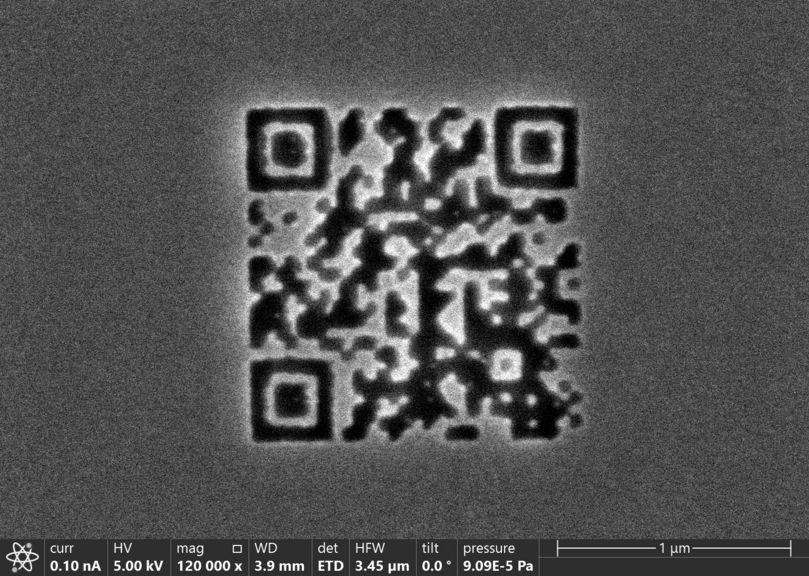
Image credit: TU Wien
Potential storage density
Using this QR‑code technology, a single‑layer film the size of an A4 sheet could theoretically store over 2 TB of data.
Advantages over existing storage media
- Durability: Laser‑etched into a thin ceramic layer, claimed to be “indefinitely” durable with no need for power or cooling.
- Energy‑free retention: Data remains stable without continuous energy input.
- Longevity comparison: Researchers liken the durability of these ceramic QR codes to ancient stone tablets, describing them as a new “jewel” for the information age.
Future directions
The teams are now focusing on:
- Writing speed improvements – accelerating data inscription onto the ceramic substrate.
- Scalable manufacturing – developing processes for larger‑scale production.
- Beyond QR codes – exploring more complex data structures that can be encoded in the same ceramic medium.
Context on Cerabyte’s recent work
Cerabyte has previously been featured in Tom’s Hardware for breakthroughs in:
- Storage density: Laser‑engraved ceramic devices targeting up to 100 PB per rack by 2030.
- Durability: Demonstrations of extreme resilience, such as surviving immersion in salt water and high‑temperature tests.
Western Digital was announced as a key investor in Cerabyte’s ceramic storage roadmap (May 2025).