
CTO Says 93% of Developers Use AI, but Productivity Is Still 10%
Source: Hacker News
Pragmatic Summit 2024 – Laura Tacho’s Keynote
I attended this year’s Pragmatic Summit and caught the keynote from Laura Tacho – CTO at DX, executive advisor, and Austrian Innovator of the Year.
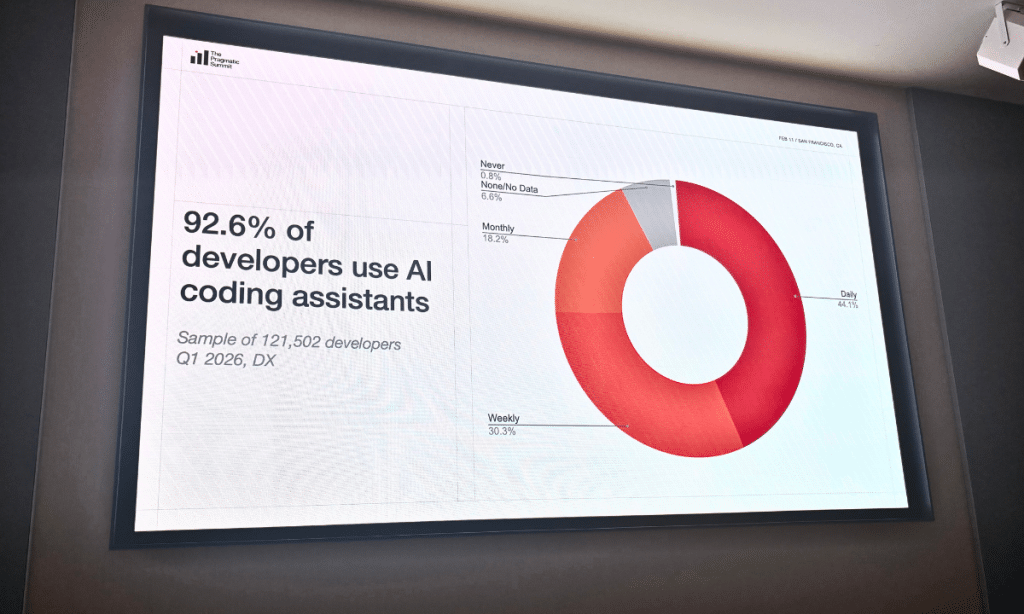
Laura presented her latest research, Measuring Developer Productivity & AI Impact, which is based on three months of data collected through February 1.
Research scope
- 121,000 developers surveyed across 450+ companies
- 92.6 % use an AI coding assistant at least once a month
- Roughly 75 % use an AI assistant weekly
The numbers make it clear: AI is no longer a side experiment; it’s now an integral part of the development workflow.
Top Takeaways
(Insert the most compelling takeaways here – e.g., productivity gains, code quality impacts, adoption barriers, etc.)
The 10 % Productivity Plateau
Key take‑aways
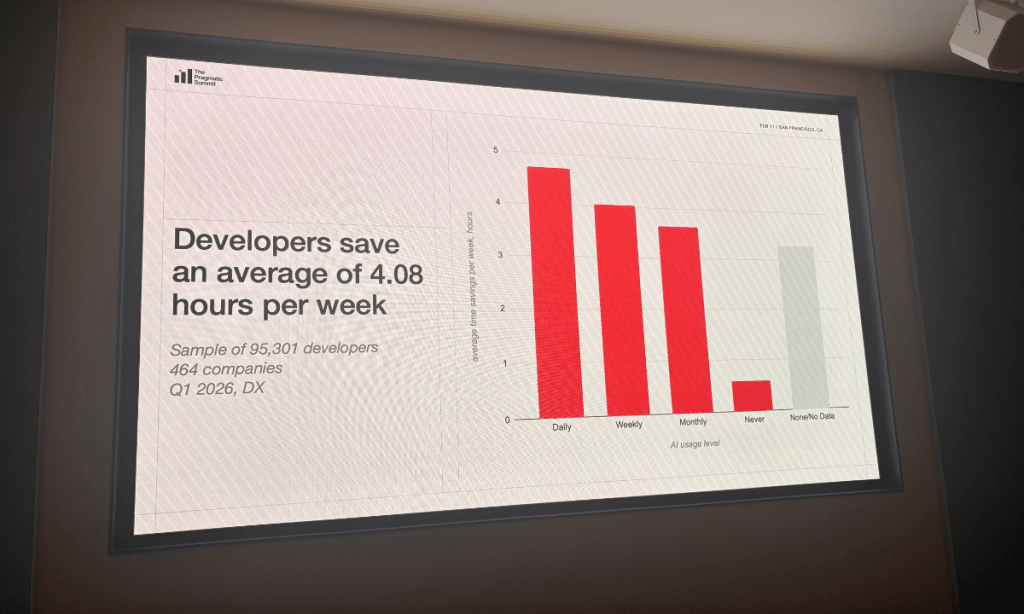
- Time saved: Developers report saving ≈ 4 h/week with AI assistance (Q2 2025). Q4 2025 numbers are slightly lower at 3.6–3.7 h/week.
- Productivity boost: After an initial jump of ≈ 10 %, productivity has plateaued at that level.
- AI‑authored code: Now 26.9 % of production code is written by AI (up from 22 % in the previous quarter).
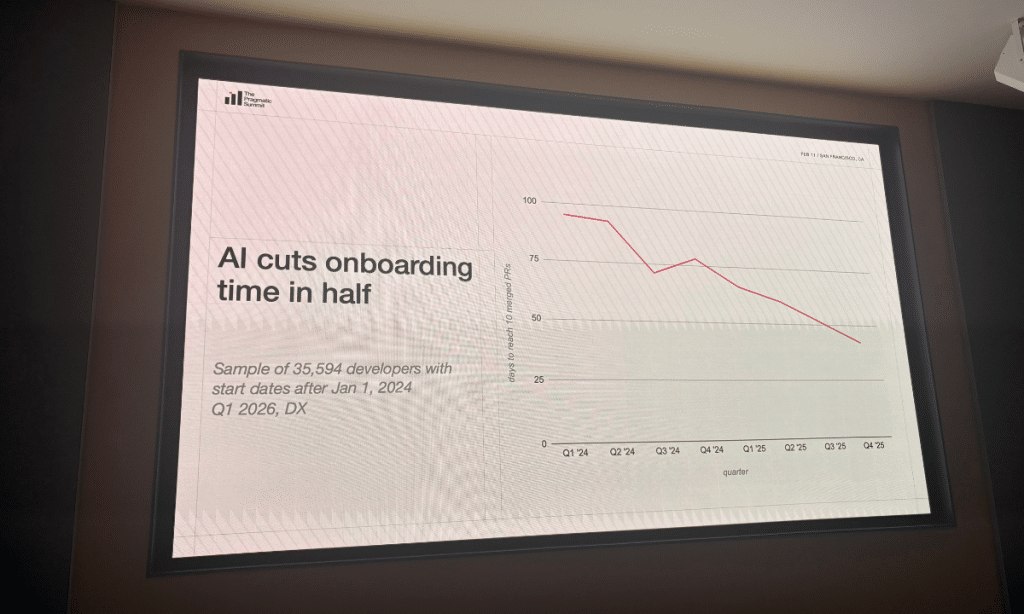
- Onboarding acceleration: “Time to the 10th Pull Request (PR)” has been cut in half from Q1 2024 → Q4 2025, shortening the ramp‑up period for new hires, project‑switchers, and non‑engineers.
Time‑Saving & Productivity Trends
Developers continue to cite time savings as the primary benefit of AI assistance. The weekly savings have steadied around 4 h, while overall productivity remains ≈ 10 % higher than pre‑AI baselines.
Rise of AI‑Authored Code
- Scope: Analysis of ~4.2 M developers (Nov 2025 – Feb 2026).
- Current share: 26.9 % of all production code is AI‑generated.
- Daily AI users: Roughly 1/3 of the code they merge (and that passes review) originates from AI.
AI‑Powered Onboarding
Metric: Time to the 10th Pull Request (PR) – a widely‑used proxy for successful onboarding.
| Quarter | Avg. time to 10th PR | % Change vs. previous quarter |
|---|---|---|
| Q1 2024 | 8 weeks | — |
| Q2 2024 | 7 weeks | –12 % |
| Q3 2024 | 6 weeks | –14 % |
| Q4 2024 | 5 weeks | –17 % |
| Q1 2025 | 4 weeks | –20 % |
| Q2 2025 | 3 weeks | –25 % |
| Q3 2025 | 2.5 weeks | –17 % |
| Q4 2025 | 2 weeks | –20 % (half of Q1 2024) |
Insight: Faster onboarding extends the productivity boost for at least two years, reducing mental load and easing entry into complex codebases.
Bottom Line
- AI has stabilized its impact on weekly time savings and overall productivity.
- The share of AI‑authored code is climbing rapidly, now approaching one‑quarter of all production code.
- Onboarding is the standout win: halving the ramp‑up time translates into longer‑lasting productivity gains and a smoother transition for new or shifting team members.
AI is no longer just a time‑saver; it’s becoming a core accelerator for code creation and talent integration.
AI in Struggling Organizations: Exposing Flaws Instead of Fixing Them
Speaker: Laura (research lead)
Key Findings
- Study scope: 67,000 developers surveyed from Nov 2025 – Feb 2026.
- Performance split:
- Some companies experienced twice as many customer‑facing incidents.
- Others saw a 50 % reduction in incidents.
The decisive factor? How AI is deployed.
| Organization Type | AI Impact |
|---|---|
| Well‑structured | AI acts as a force multiplier: faster delivery, higher quality, better reliability. |
| Struggling | AI merely highlights existing flaws without fixing them. |
Laura’s Conclusions
“Transformation is uncomfortable. Organizations that were ready to quit their cloud or agile transformations are now giving up on AI transformation, too. It’s difficult to look at an entire organization and realize that something fundamental must change to see a real impact on the bottom line.”
- Adoption ≠ Results – Simply using AI tools does not automatically improve an organization.
- Management problem: Hype suggests AI will “pay off” on its own, but most tools are still used for isolated coding tasks. Real impact requires organizational‑level adoption, not just individual tasks.
Popular AI Tool: Codex
- Launch: Desktop app released Feb 2, 2026.
- Adoption: > 1 million downloads; +60 % growth in the last week.
- OpenAI internal usage: 95 % of developers use Codex, generating ~60 % more Pull Requests per week.
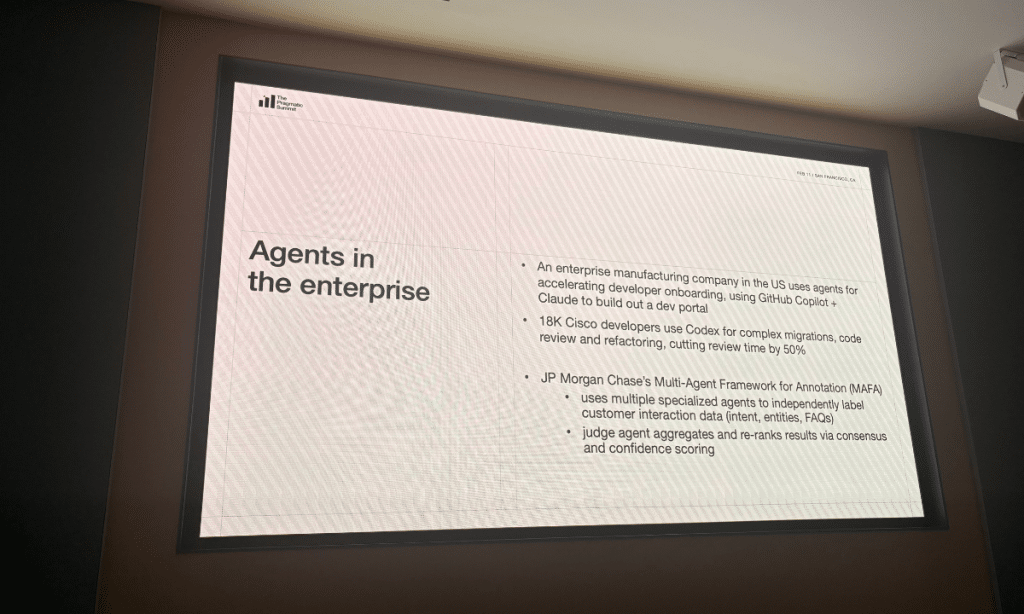
Real‑World Example: Cisco
- 18,000 engineers use Codex daily for complex migrations and code reviews.
- Result: Code‑review time cut in half.
“AI won’t fix deeper organizational issues unless you tackle those problems head‑on, and that starts with acknowledging they exist.” – Laura
Systemic Constraints
“I am skeptical of any technology’s promise to improve performance without addressing those underlying constraints. If we don’t solve our systemic issues, we’ll just ‘carry them into space with us.’ The real question isn’t how to colonize Mars, but how to achieve actual organizational impact.”
Visual
Takeaway: AI can be a powerful accelerator, but only when organizational structures, processes, and culture are ready to support it. Without addressing systemic friction, AI merely shines a light on existing problems.
DevEx Is More Important Than Ever
To wrap things up, Laura revealed the secret to success for those who are “winning” with AI:
- Set clear goals and measure results.
- Recognize that Developer Experience (DevEx) matters more than ever.
- Ensure AI succeeds by having fast Continuous Integration (CI), clear documentation, and well‑defined services.
At the end of the day, getting real organizational results means treating AI as a company‑wide challenge. The research shows the barriers aren’t technical; they come down to change management and leadership support.
Laura’s Takeaway
Successful organizations experiment by tackling real customer problems. Exploring Mars sounds exciting, but it’s not sustainable—it’s expensive and distracts from the core business. Focus your experiments on the customer to drive meaningful results. After all, somewhere, something incredible is waiting to be discovered.
Really enjoyed your talk, and I really appreciated our chat afterward!