Chevrolet killed it then brought it back, now we drive it: The 2027 Bolt
Source: Ars Technica
The McRib of EVs
Faster charging, more modern infotainment, and a new LFP battery are highlights.
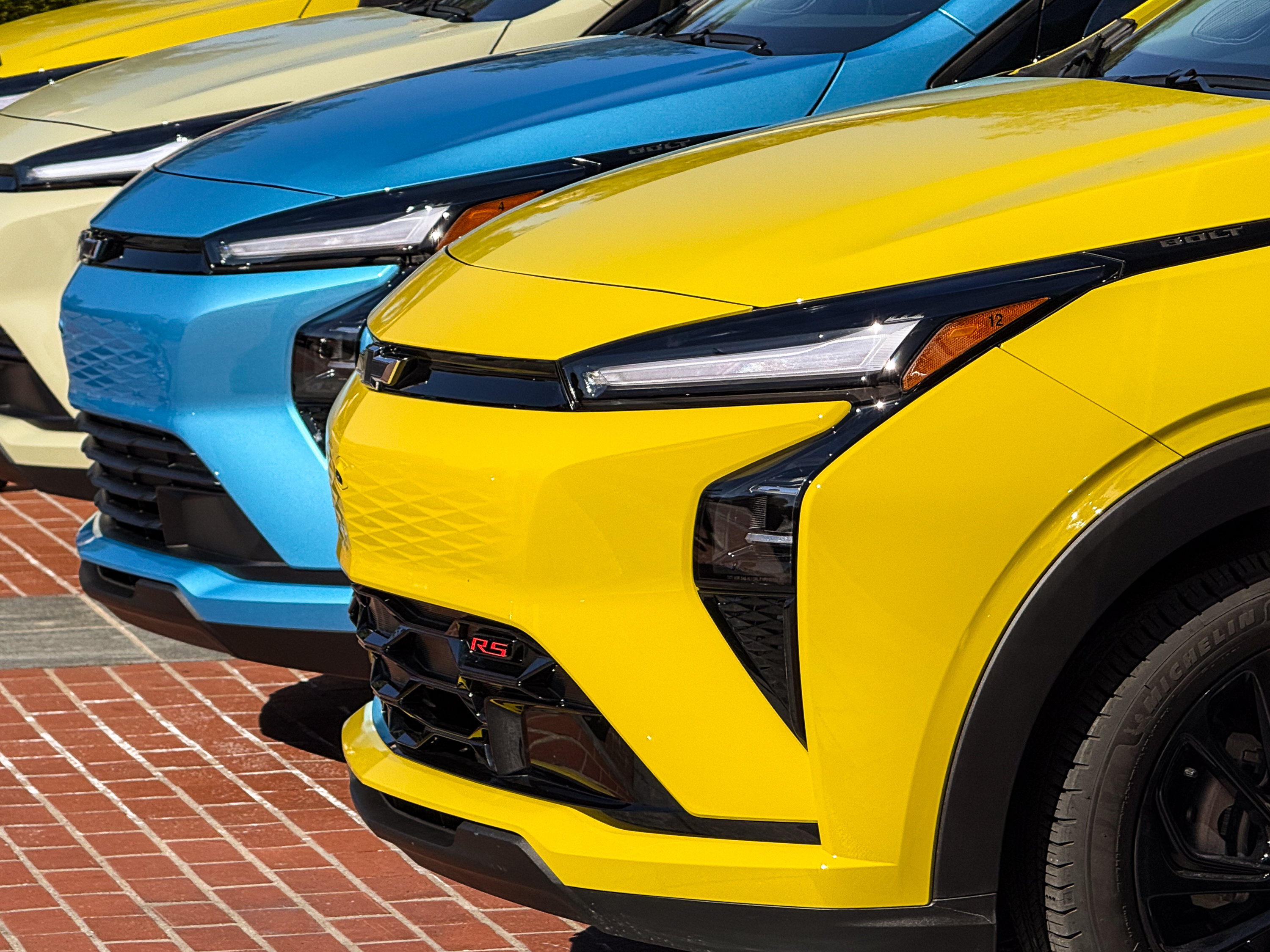
Credit: Jonathan Gitlin
It’s back!
WESTLAKE VILLAGE, Calif. — When the Chevrolet Bolt debuted in 20171, the electric hatchback stood out: an EV with more than 200 mi of range for less than half the price of a Tesla Model S. The Bolt had its ups and downs, though. A $1.8 billion recall2 saw GM replace the battery packs in more than 142 k cars, which wasn’t great. COVID delayed the Bolt’s mid‑life refresh a little, but it eventually got a price cut—the first of several—plus new seats, infotainment, and even the Super Cruise driver‑assist system, as well as a slightly larger version called the Bolt EUV.
Along the way, the Bolt became GM’s bestselling EV by a wide margin, even as the OEM introduced its new range of more advanced EVs using the platform formerly known as Ultium. But, as is often the case with General Motors, a desire to repurpose the Bolt’s assembly plant led to the car’s cancellation. GM wanted to retool the Orion Township factory for its full‑size electric pickups3 like the Silverado EV. Consequently, in 2022 GM CEO Mary Barra announced the Bolt’s impending demise.
The announcement was not well‑received. Even though Chevrolet promised an almost‑as‑cheap Equinox EV4, Bolt fans rallied and engineered a volte‑face. At CES 2023, Barra revealed the Bolt would be brought back with an all‑new lithium‑iron‑phosphate (LFP) battery in place of the previous lithium‑ion pack. When the Bolt was originally designed, it was GM’s sole EV; now there’s an entire (not‑) Ultium model range. The automaker also has a giant parts bin to draw from, so the Equinox EV donates its drive motor, and the new Android Automotive OS infotainment system makes its debut.
You could have read all that ages ago. Chevrolet announced some specs and pricing last October5, including a sportier RS trim alongside the LT version. In January6 we learned the 2027 Bolt would have a 262‑mile (422 km) range and could DC fast‑charge at up to 150 kW using a NACS socket instead of CCS1. Now we’ve spent some time behind the wheel of the 2027 Bolt, and here’s what we found.
References
Spec Sheets Can Be Misleading
As before, the Bolt’s electric motor drives its front wheels. The drive unit now generates 210 hp (157 kW) – a 4 % bump over the previous model – but its torque output is only 169 lb‑ft (230 Nm), down from the 266 lb‑ft (360 Nm) of earlier Bolts. This initially worried me: near‑instant, effortless torque practically defines the EV driving experience, and losing nearly 40 % of that thrust seemed like it would make for a radically different ride.
In fact, the 2027 Bolt is slightly zippier than the old car. Although the motor’s torque is lower, the final‑drive ratio is 11.99 : 1, so you’d never guess it. Zero‑to‑60 mph (97 km/h) now takes 6.8 seconds, 0.2 seconds quicker than before. The new motor can spin faster, providing ample acceleration even at highway speeds.
If you’re looking for a new EV for between $30,000–$40,000 there’s an awful lot of choice now.
— Jonathan Gitlin
The new powertrain is also more efficient. Even though much of our drive route was on challenging, hilly roads like Mulholland Drive down to Malibu, and we spent most of the time in Sport mode, I still saw around 4 mi/kWh (15.5 kWh/100 km). That makes the 262‑mile range estimate from the 65 kWh battery pack feel spot‑on.
Perhaps the old Bolt’s biggest weakness was its slow DC charging – almost an hour to reach 80 % at a maximum of just 55 kW. With the new NACS connector, things are a lot better. I tested recharging a Bolt LT from 19 % to 80 % using a Tesla V4 Supercharger; it took 25 minutes and added an indicated 211 miles of range. The charge curve is much flatter than before, starting at ~110 kW before gradually ramping down once the state of charge passes 65 %. Like other batteries, the LFP pack slows its charge after 80 %, but unlike conventional lithium‑ion packs you’re encouraged to charge to 100 % as often as possible.
For most charging networks, recharging is as simple as plugging in and letting the car and charger communicate via Plug‑and‑Charge (ISO 15118). This is still being rolled out for Tesla Superchargers, but you can initiate a charge from the Bolt’s charging app.
A word of caution: the charge socket is on the driver’s side, which can make using a V3 Supercharger (with its short cable) tricky – you may end up blocking more than one stall, which could annoy nearby Tesla owners.
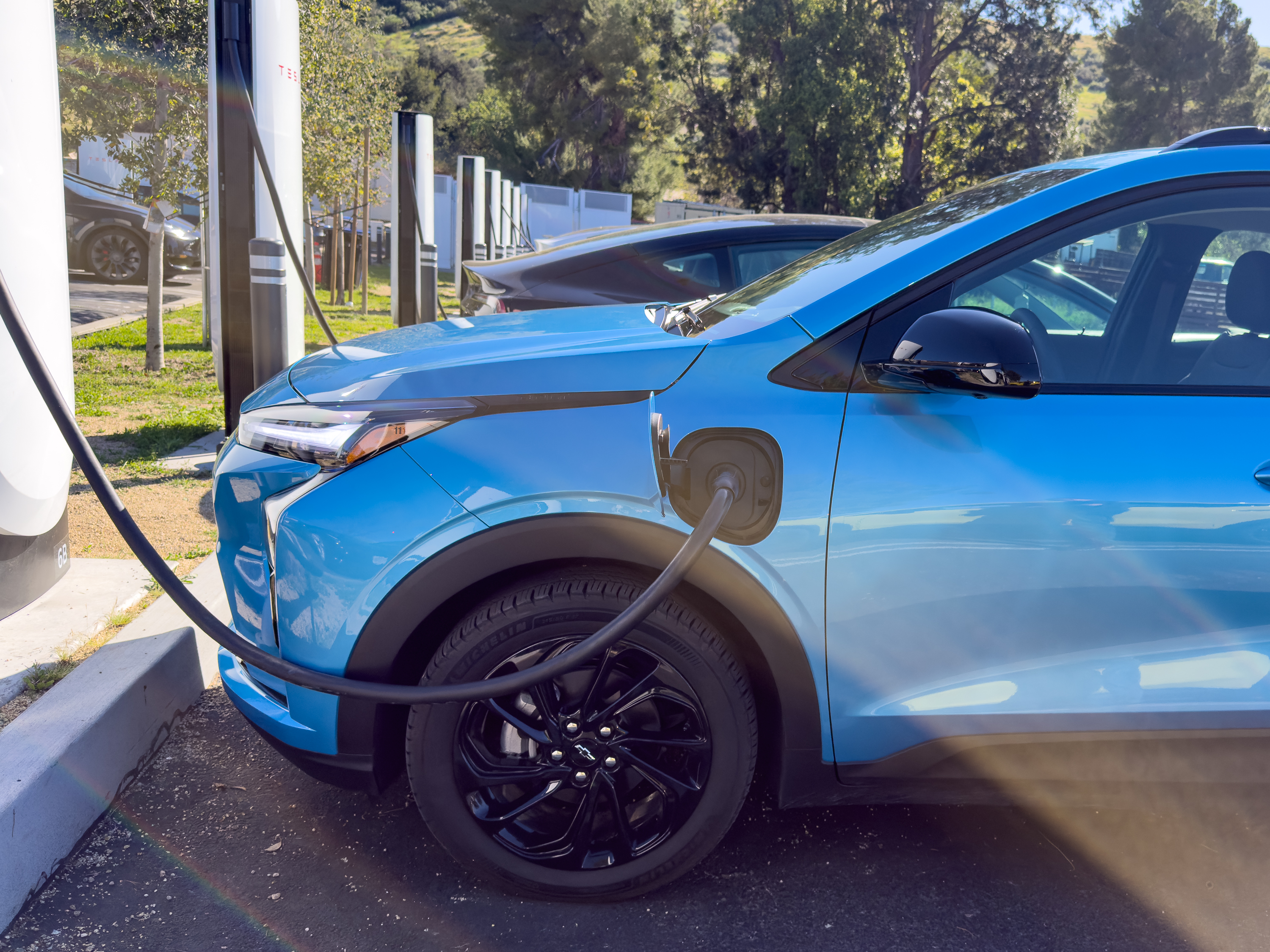
Fast‑charging is actually fast now.
Credit: Jonathan Gitlin
And before you ask, no – relocating the charge port isn’t feasible. It would require a major redesign of the car’s unibody and power‑train layout, incurring a prohibitive cost.
Drives Like a Bolt Should
Although the new $32,995 RS trim has a sportier appearance inside and out than the $28,995 LT, both trims use identical suspension tuning. The ride is more than a little bouncy over the expansion gaps of LA’s highways, but a look at previous reviews reminds me that older Bolts also behaved this way. The effect was much less noticeable on back roads, where the car proved nimble—if not exactly captivating—to drive. I would very much like to try one on performance tires; the range would suffer a little, but cornering grip would be much improved. That said, the low‑rolling‑resistance tires have more grip and are less likely to break traction than, say, the Toyota bZ we just reviewed.
There’s a new power‑steering actuator and a new rear‑twist axle, but the suspension and steering geometry should be the same as older Bolts.
What’s New Compared to the Old Bolt
- Cabin storage – More nooks and cubbies than before.
- Instrument panel & infotainment – Both are larger than on a 2023 Bolt.
- Gear selector – Now a stalk mounted on the steering column (D/R/N/P).
- One‑pedal mode – Toggled via a persistent icon on the touchscreen rather than a physical switch.
- Regenerative‑braking paddle – Gone from behind the steering wheel.
These changes make the new Bolt feel less convenient than the older model, which relied on physical controls.
The new cabin. The seats are better but lack lateral support. If you want wireless phone charging, you’ll have to spend $1,195 on the tech package.
— Jonathan Gitlin
One‑Pedal Driving & Regeneration
There are two one‑pedal settings: a gentler mode and a more aggressive one. Regeneration also occurs when you lift off the accelerator, even with one‑pedal mode off. The amount of regen before the friction brakes engage depends on factors such as the battery’s state of charge. In high‑regen mode I saw up to 85 kW when lifting the throttle, and a similar figure when using the brake pedal to slow the car with one‑pedal mode disabled.
With one‑pedal turned off, the car still regenerates a few kilowatts when you lift the accelerator, so, unlike many German EVs, this Bolt won’t coast freely.
Is this the McRib of EVs?
Any worries that the rebatteried Bolt would be missing the car’s essential character were misplaced. Although some of the numbers on paper look lower, the driving experience is no worse than the old car in most ways, and improved in terms of onboard safety systems, powertrain efficiency, and so on. The comments will no doubt reflect antipathy that GM dropped Apple CarPlay and Android Auto to cast one’s phone, but the inclusion of apps like Apple Music might go some way toward alleviating this angst. In all, the 2027 Bolt represents a solid upgrade.
But there’s a catch. Just like last time, GM has other designs on the Bolt’s assembly plant—now in Fairfax, Kansas. That factory will churn out Bolts for just 18 months; next year production ends and the automaker repurposes the site to build gasoline‑powered Buick Envisions and Chevy Equinoxes. Chevy told us that it expects there will be sufficient Bolts to stock dealerships for the next two years, but after that, it’s done.
Author

Jonathan M. Gitlin – Automotive Editor at Ars Technica
BSc and PhD in Pharmacology. In 2014 he left the National Human Genome Research Institute to pursue his lifelong passion for cars and launched Ars Technica’s automotive coverage. He lives in Washington, DC.
274 Comments