
Building a Content-First Web Runtime (UI as a Lens, Not a Template)
Source: Dev.to
Most web apps today follow the same pattern:
- design pages
- write components
- add routes
- repeat layout logic forever
- ship CSS for every new surface
Even with modern frameworks, we still rebuild the same idea of a page over and over.
So I started exploring a different approach:
What if pages weren’t authored as UI… but as structured content + intent?
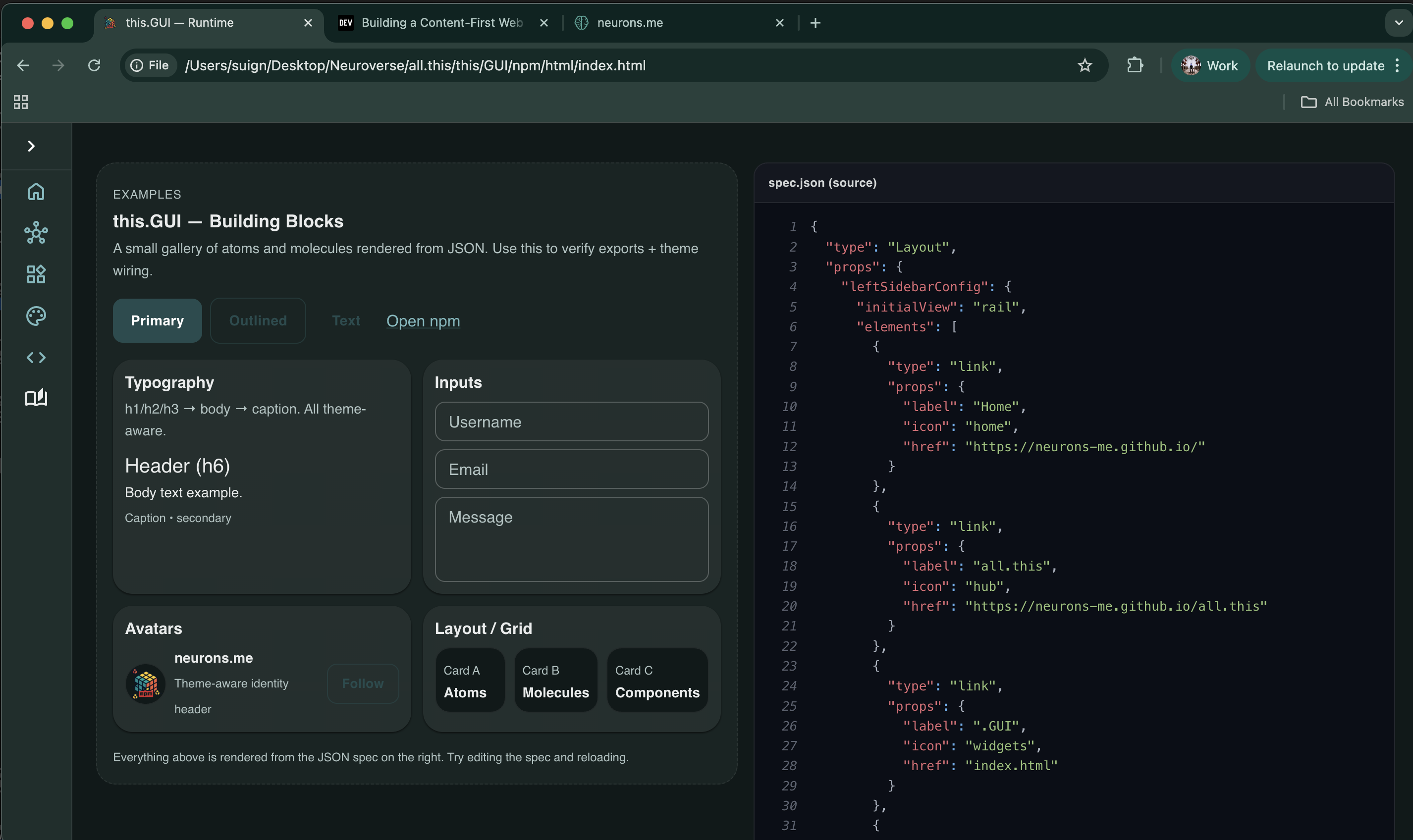
That’s what I’m building: a content‑first runtime where the interface is not fixed and pages are declared as JSON nodes.
The Idea
Instead of building UIs like:
// traditional component treeI declare them like:
{
  "type": "Layout",
  "props": {
    "leftSidebarConfig": {
      "initialView": "rail",
      "elements": [
        { "type": "link", "props": { "label": "Home", "icon": "home", "href": "/" } },
        { "type": "link", "props": { "label": "Catalog", "icon": "palette", "href": "/catalog" } }
      ]
    }
  },
  "children": [
    {
      "type": "Page",
      "props": { "title": "Runtime demo" },
      "children": [
        { "type": "Button", "props": { "variant": "contained" }, "children": ["Click me"] }
      ]
    }
  ]
}
Then the runtime mounts it:
GUI.mount(spec, "#root");Why This Is Different
- ✅ UI is just a renderer
- ✅ Layout is reusable across everything
- ✅ Navigation becomes data
- ✅ Pages become focus spaces
- ✅ Content becomes the primary artifact
Navigation as a Link List
Instead of hard‑coding sidebars, navigation becomes a list of link nodes:
{
  "type": "link",
  "props": {
    "label": "Storybook",
    "icon": "auto_stories",
    "href": "https://example.com"
  }
}
Now every surface can share the same navigation rules, theme wiring, and layout logic—no need to rebuild “the sidebar” ever again.
This Starts Feeling Like a Browser
At some point I realized: I’m building a browser for structured content. The runtime becomes:
- a layout engine
- a theme engine
- a node renderer
- an interaction router
Everything else is just content. Pages stop being templates and become spaces where content lives.
Why AI Fits Naturally Here
This model is perfect for AI. Instead of generating full React projects, AI can generate small specs:
{
  "type": "Page",
  "props": { "title": "Themes" },
  "children": [
    { "type": "ThemesCatalog", "props": { "minimal": true } }
  ]
}
No CSS, no routing glue, no component wiring—just structured meaning that the runtime renders.
What I’m Working Toward
The next step is to formalize this into a “site spec”:
{
  "site": "this.GUI",
  "nav": [ /* … */ ],
  "pages": {
    "/": { /* spec */ },
    "/catalog": { /* spec */ }
  }
}
So the runtime becomes a real content browser:
- load routes
- mount specs
- reuse layouts
- generate focus dynamically
The Core Principle
Don’t build interfaces. Build runtimes that interpret meaning.
When you do that… UI becomes a lens, not a template.
If you’ve felt this pain too, you might enjoy this direction. I’m building it openly as part of neurons.me.