
Beyond the Chatbot: A Blueprint for Trustable AI
Source: Google Developers Blog
JAN. 29, 2026
Ajeet Mirwani – Americas Program Lead, Google Developer Experts
At 100 mph, there is no room for an AI “hallucination.”
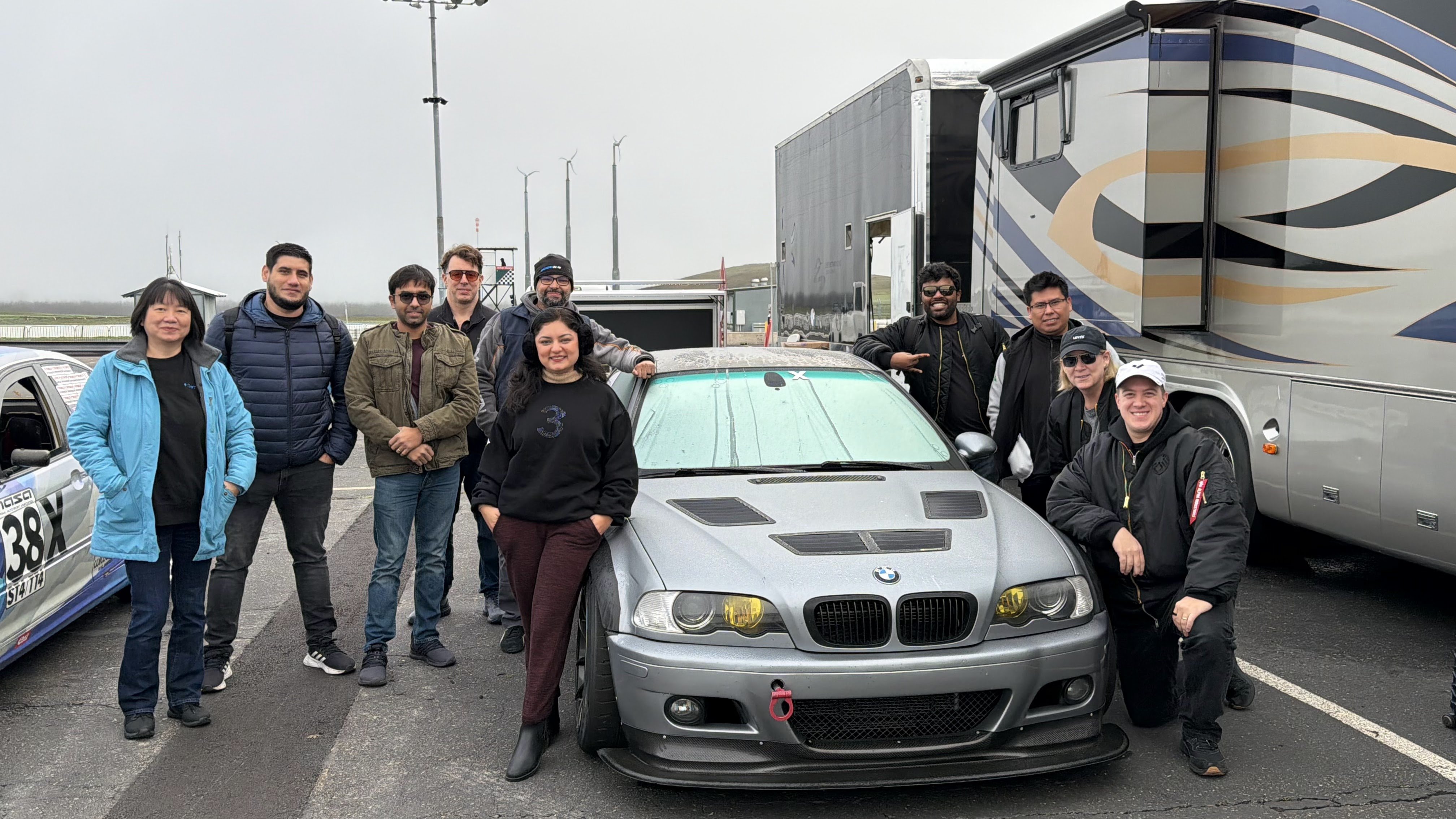
When a race car approaches a high‑speed corner at Thunderhill Raceway in Willows, CA, the difference between a perfect line and a dangerous skid is measured in milliseconds. Traditionally, performance telemetry has relied on static code that tells you what happened after the fact. A small team of Google Developer Experts (GDEs) wanted to see if AI could move into the driver’s ear in real‑time, transforming raw data into trustworthy, split‑second guidance.
Agent‑Led Development with the Unified Journey
The most remarkable part of this test wasn’t just the result, but the speed of development. Leveraging Antigravity (AGY)—Google’s new framework for orchestrating stateful agentic systems—the team used natural‑language‑driven orchestration to compress a three‑month development cycle into just two weeks.
- The AGY Agent Manager accelerated the workflow by handling high‑scale cold‑path data processing and boiler‑plate physics logic, letting the GDEs focus on high‑level system behavior through “vibe coding.”
- The project served as a stress test for Google’s Unified Developer Journey. The GDEs began with rapid prototyping in Google AI Studio, then used that blueprint to transition to Vertex AI—the “pro‑tier” path for production‑grade systems.
- Instead of writing thousands of lines of boiler‑plate physics code, the GDEs described desired agentic behaviors in natural language, anchoring the architecture for high‑scale processing and real‑time state management via Firebase.
The “Split‑Brain” Architecture
The framework’s foundation is a “Split‑Brain” architecture that separates “reflexes” from “strategy.” To manage this complex deployment, the GDEs operated in specialized strike teams.
Intelligence Team
Implemented the multi‑tier system:
- Gemini Nano runs at the edge for split‑second reflexes.
- Gemini 3.0 handles higher‑level reasoning and strategic lap analysis.
Margaret Maynard‑Reid led the daily stand‑ups.
Edge Team
- Sebastian Gomez – LinkedIn
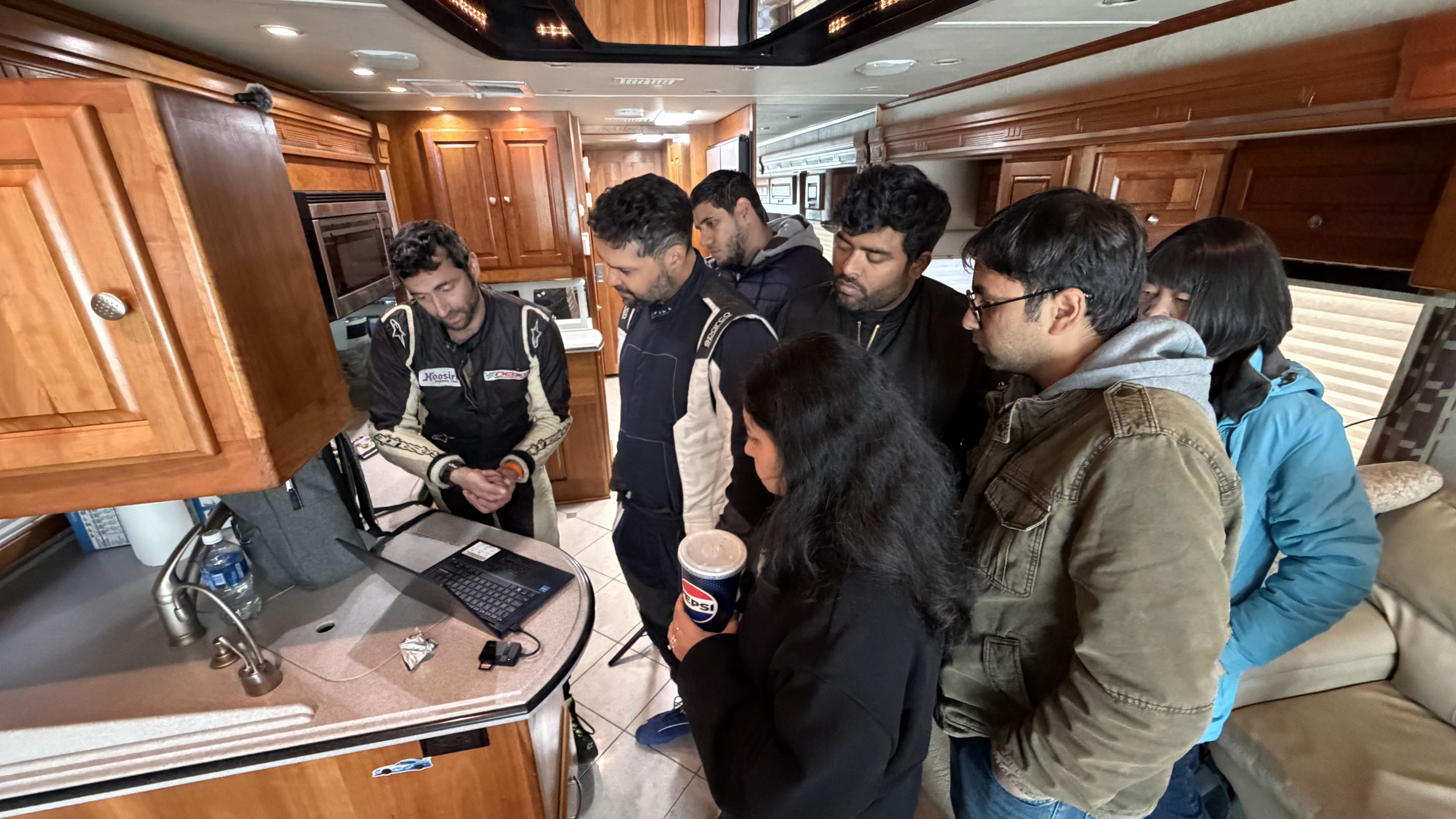
Spearheaded the use of Nano in Chrome via the Web API to achieve ~15 ms response times. - Austin Bennett – Managed the complex hardware configuration required to keep the “Data Crucible” node alive at speed.
Perception Team
- Hemanth HM – LinkedIn
- Vikram Tiwari (also on Intelligence)
Implemented the application layer:
- Utilized Maps MCP to help the system “see” the track layout.
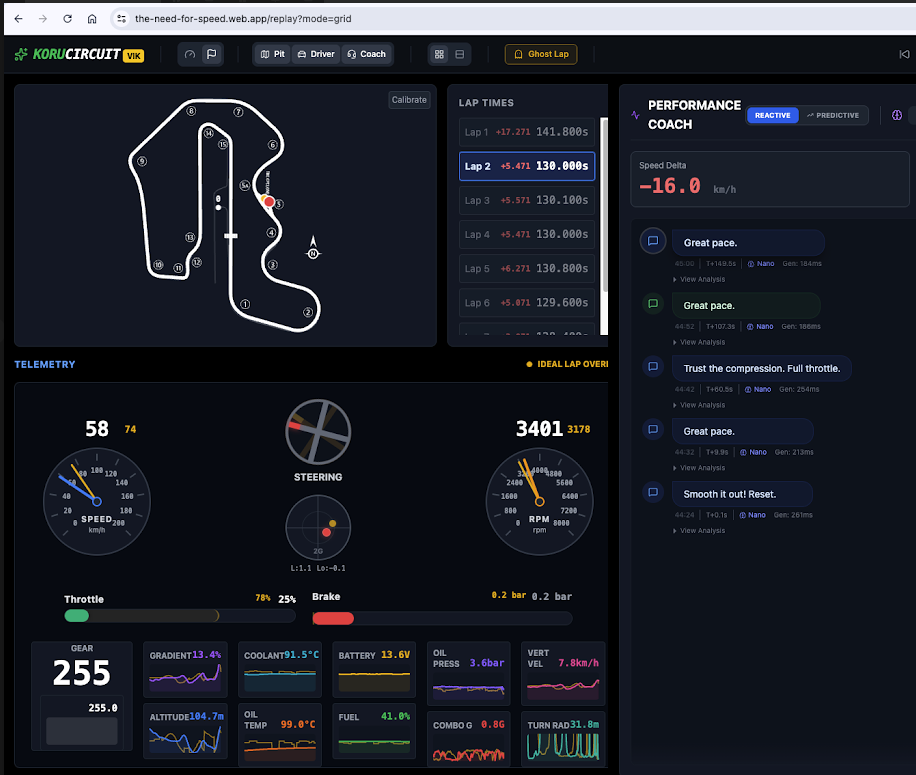
- Rendered real‑time 3D telemetry at 60 FPS, enabling “ghost analysis” of the driver’s line versus the AI’s physics‑based recommendations.
Antigravity served as the orchestration layer between Gemini Nano’s edge reflexes (~15 ms) and Gemini 3.0’s strategic reasoning, automating hand‑offs and maintaining real‑time state management even at speeds exceeding 100 mph.
Mathematically Verifiable Coaching
Trust is built on verification. Rabimba Karanjai – LinkedIn – implemented a Neuro‑Symbolic Training method to ensure the AI’s advice is grounded in physics.
- Fine‑tuned the models on a “Golden Lap” baseline using QLoRA.
- The system can mathematically verify its own coaching. If the AI tells a driver to “brake later,” it’s because the framework has validated that advice against the laws of physics.
The team used a Draft → Verify → Refine agentic loop for real‑time triage:
- Draft – AGY Agent Manager proposes code fixes when data friction appears in the pit lane.
- Verify – Automated browser tests validate the logic against telemetry baselines.
- Refine – Validated updates are pushed to the car’s “Data Crucible” between laps.
This self‑correcting workflow guarantees that coaching advice (e.g., “brake 20 ft later”) is always physics‑based and pre‑verified for safety.
The “Gemini Squad”: Grounding in Pedagogy
To bridge the gap between data and human understanding, Lynn Langit – LinkedIn – introduced persona‑based routing grounded in “Human Pedagogy.”
The framework employs a Gemini Squad of agents—such as AJ the Crew Chief and Ross the Telemetry Engineer—to deliver context‑aware guidance. By injecting pedagogical personas, the system translates raw telemetry into actionable, driver‑friendly instructions, ensuring that the AI’s recommendations are both technically sound and intuitively understandable.
Ground Truths: The Next Field Test
The Thunderhill field test proved that the AI Trust Gap can be closed using a split‑brain architecture and Google’s Unified Developer Journey. After reviewing the system’s output, Thunderhill CEO Matt Busby remarked:
“You guys have done more in a day than the entire industry has done in 40 years. This system makes racing data repeatable and accurate by marrying gut feeling with objective logic—it’s light years ahead of what exists in the market today.”
Ready to Build?
As this group of GDEs demonstrated, the leap from experimental prototypes to production systems is complex, but navigable. If you’re ready to move beyond vibe coding and start building on the pro‑tier of Vertex AI, get started with our ADK Crash Course and build sophisticated, autonomous systems that can reason, plan, and use tools to accomplish complex tasks.
Deep Dives from Our GDEs
- Trust at Top Speed – Jigyasa Grover: Orchestrating the split‑brain architecture.
- A Split‑Brain Neuro‑Symbolic Training Method – Rabimba Karanjai: Fine‑tuning for safety and verifiability.
- Racing at the Edge – Lynn Langit: Managing cognitive load and persona routing.
- Taking AI Agents to the Track – Hemanth HM: Browser‑based models and Maps integration.
- The Race for Real‑Time – Vikram Tiwari: 60 FPS rendering and a 4‑tier hierarchy.

Photo captured by @gotbluemilk