
Beyond CRM: How Salesforce Engineered an Enterprise Agent Platform for Any Workload
Source: Salesforce Engineering
**Source:** [Salesforce Engineering](https://engineering.salesforce.com/beyond-crm-how-salesforce-engineered-an-enterprise-agent-platform-for-any-workload/)

**By Muralidhar Krishnaprasad**

Enterprises move quickly to adopt agent‑based systems, yet many still assume they need to assemble bespoke stacks on hyperscalers to support serious, non‑CRM workloads. Inside Salesforce Engineering, the challenge looked different. Our goal: design **[Agentforce](https://engineering.salesforce.com/how-agentforce-data-and-apps-turned-the-salesforce-stack-into-agentforce-360/)**, **Data 360**, and the broader platform as the enterprise‑standard agent foundation. This foundation supports mission‑critical systems, rich data context, and long‑lived agent lifecycles without being tied to any single product surface.

Join us as we explore how Salesforce Engineering solved that problem at the platform level. We will examine how established perspectives shaped architectural choices, how the team integrated trust and governance from the start, and how we prioritized data, metadata, and transparency to build an agent platform that scales across enterprises and ecosystems.
Extending Salesforce Beyond CRM to Power Enterprise Agent Workloads
Salesforce not only powers sales and service workflows for enterprises worldwide, but its foundation now reaches far beyond traditional CRM tasks. Agentforce and Data 360 support enterprise‑grade agent systems across diverse industries and mission‑critical environments.
Why Agentforce Matters
- Open, extensible, and customizable – built with a focus on flexibility rather than CRM‑centric constraints.
- Primitives such as AgentScript and AgentGraph introduce deterministic structure into otherwise non‑deterministic systems.
- These primitives do not rely on CRM objects or workflows; they provide a generic mechanism for orchestrating tools, actions, and reasoning flows across enterprise systems.
How It Works
- Design agents that manage policy engines, custom back‑ends, and industry‑specific logic within a single architecture.
- Governance & reliability – Salesforce supplies the tools and oversight needed to run workloads at enterprise scale.
- Data 360 acts as the “system of context,” harmonizing data from inside and outside the CRM so agents can reason over structured data, unstructured data, and metadata.
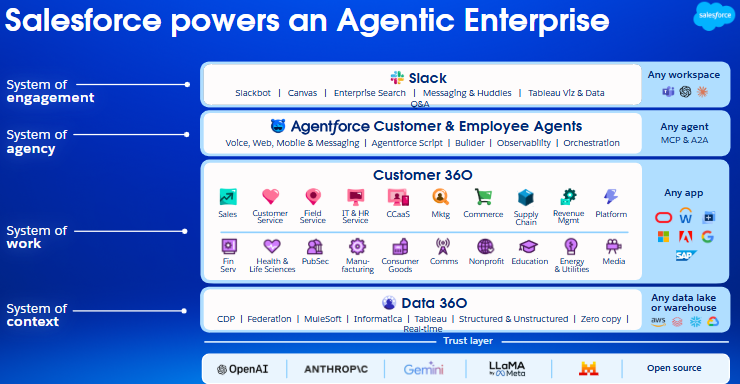
Engineering Enterprise Trust, Security, and Governance for Agents
Enterprise agents operate close to sensitive data, business processes, and user identity. This proximity makes trust a non‑negotiable requirement. Because even small failures in isolation or access control can cause outsized consequences, the architecture treats trust as more than an application‑level concern.
Agentforce Foundations
Agentforce builds on the core Salesforce platform capabilities—identity, credential context, and policy enforcement—and adds specific protections for agentic behavior:
| Feature | Purpose |
|---|---|
| Dedicated trust layer | Mitigates threats such as prompt injection and impersonation. Critical variables are sourced from trusted actions and governed data inputs rather than raw user prompts. |
| Agent identity as a first‑class concept | Enables secure interactions both within Salesforce and across external systems. |
Data Governance
Data governance remains a priority throughout the Agentforce and Data 360 integration pipeline. The system enforces rigorous guardrails and validates data before it undergoes:
- Chunking – breaking data into manageable pieces.
- Indexing – creating searchable representations.
- Exposure for reasoning – making data available to agents via Retrieval‑Augmented Generation (RAG).
These steps ensure that only policy‑compliant information is RAG‑ed into an agent’s context.
Outcome
Together, these controls allow agents to:
- Operate across multiple systems and vendors.
- Preserve enterprise expectations around security, auditability, and data protection.
The result is a trustworthy, governed environment where agents can safely augment business processes without compromising sensitive information.
Context Beyond Data — Metadata, Personalization, Memory, and Insights for Reliable Agent Reasoning
Reliable agent reasoning requires more than raw data and tools; it also needs deep metadata, semantic grounding, and personalized context.
Key Components
Metadata Enrichment
- The core platform and Data 360 derive relationships, extract implicit structures, and apply business glossaries.
- This creates rich semantic representations that agents can reason over, reflecting actual meaning rather than static declarations.
Conversation Memory
- Data 360 stores agentic conversation history and other engagement signals.
- These signals are curated into short‑term, long‑term, and episodic memory contexts for the agent to reference.
Personalization Profiles
- Preferences, historical interactions, and behavioral signals are unified into an intelligent context layer.
- This enables agents to respond in a personalized, user‑centric manner.
When enriched metadata, personalization, and memory context are combined with core data and tool context, they form a powerful foundation for reliable, trustworthy enterprise‑grade reasoning.
Keeping the Agent Platform Open Across Models, Tools, and Execution Surfaces
Agentforce is deliberately designed to be model‑agnostic and tool‑agnostic:
| Dimension | How Agentforce Supports Openness |
|---|---|
| Model | Supports LLMs, retrieval‑augmented generation, and hybrid reasoning engines via a plug‑in architecture. |
| Tooling | Exposes a unified SDK for custom tool integration, allowing teams to register APIs, functions, or external services without platform changes. |
| Execution | Runs on Salesforce’s multi‑tenant cloud, on‑premises data centers, or any hyperscaler through containerized workloads, preserving consistent security and governance guarantees. |
This openness ensures that enterprises can evolve their AI stack over time—adopting new models, swapping out tools, or extending execution environments—while retaining the same trust, governance, and data‑context guarantees.
Takeaways
- Agentforce + Data 360 provide a unified, enterprise‑grade foundation for building, governing, and scaling agents beyond CRM.
- Trust, security, and governance are baked in from the start, not bolted on later.
- Deep metadata, memory, and personalization turn raw data into actionable context for reliable reasoning.
- The platform remains open to any model, tool, or execution surface, protecting your investment as AI technology evolves.
Explore the linked articles for deeper technical details, and consider how this architecture might solve your organization’s agent‑centric challenges.
Flexibility for Modern Enterprises
Customers demand flexibility. They need the freedom to choose models, integrate existing tools, and deploy agents across different surfaces. Locking into a single model provider or workflow is no longer viable for modern business.
Agentforce supports multiple reasoning and prompt‑build models, including those users provide. It leverages open standards like MCP to enable structured sharing of data and context and consistent tool invocation among AI agents and external systems. It also uses open standards like A2A to support orchestration of agents running both within and outside the Agentforce ecosystem.
- MCP integration – Users can expose tools through MCP servers they host internally, via the MuleSoft Agent Registry as part of the MuleSoft Agent Fabric, or elsewhere, making them immediately available to agents.
- Seamless reuse – This approach integrates existing systems without duplicating tooling or rewriting logic.
Agents operate across various surfaces. Users can access Agentforce agents from Salesforce applications or external interfaces to meet users where they work. This flexibility supports incremental adoption so teams can start with focused use cases and expand as confidence grows.
All of this sits on Data 360’s open approach to a common data foundation via connectors and zero‑copy operations with major ecosystem vendors, along with open‑format file‑based data sharing.
Avoiding Fragmentation in Multi‑Vendor Agent Systems
Architectural fragmentation becomes a problem when teams adopt agents from multiple vendors. Separate stacks for reasoning, orchestration, and governance increase coordination overhead and make it harder to maintain a consistent security posture.
MuleSoft Agent Fabric
MuleSoft Agent Fabric solves this problem by providing a single, unified layer that works across any vendor’s agents.
| Capability | What It Does | Why It Matters |
|---|---|---|
| Agent discovery | Registers agents automatically and makes them searchable | Eliminates manual inventory and reduces onboarding time |
| Cross‑platform orchestration | Executes workflows that span heterogeneous agents | Guarantees end‑to‑end process continuity |
| Identity propagation | Passes authenticated identity tokens between agents | Preserves security context without re‑authentication |
| Governance & observability | Central dashboards, audit logs, and policy enforcement | Provides visibility and compliance across the whole ecosystem |
Policy‑Controlled Context Sharing
A core feature of Agent Fabric is policy‑controlled context sharing:
- Fine‑grained policies – Define exactly which data elements may flow between agents.
- Layered enforcement – Policies are applied at both the data and interaction layers, preventing accidental leakage.
- Dynamic updates – Adjust policies without redeploying agents, enabling rapid response to new compliance requirements.
By using these policies, organizations can:
- Prevent unintended data exposure while still allowing necessary collaboration.
- Maintain strict isolation between agents from different vendors or business units.
- Audit every data exchange, supporting regulatory compliance and forensic analysis.
Bottom line: MuleSoft Agent Fabric lets you register and orchestrate agents—no matter the vendor—while preserving isolation, ensuring observability, and enforcing precise data‑sharing policies across the entire multi‑vendor ecosystem.
Agent Monitoring and Observability — Operating a Fleet of Agents in Production
Enterprise agent programs don’t fail in the build phase—they fail after the first successful deployment. Once agents start handling real customer and employee work, the system can turn into a “black box”: users see outcomes, but not the reasoning path, tool calls, or configuration gaps that caused them. At that point, monitoring is no longer a nice‑to‑have SRE add‑on; it becomes a core platform capability for trust, reliability, and iteration speed.
Agentforce approaches this problem by treating observability as a single mission‑control for both IT and business teams—not just dashboards, but a feedback system that connects production behavior back to configuration changes. Agentforce observability is positioned explicitly around this loop:
- Monitor – capture real‑time metrics, tool invocations, and decision traces.
- Analyze – surface anomalies, latency spikes, and cost drivers.
- Optimize – feed insights back into prompt, model, or workflow adjustments.
This near‑real‑time inspection combines deep technical visibility with adoption and consumption metrics, allowing teams to tie agent behavior to outcomes and cost.
Looking Ahead
Agentforce and Data 360 engineering decisions reflect a core platform philosophy: build foundational capabilities first so higher‑level agent behaviors emerge safely. By prioritizing trust, context, and interoperability, the platform supports both single‑agent use cases and complex multi‑agent systems, extending the manageability of multi‑vendor agents with MuleSoft Agent Fabric.
Responsible agent adoption requires solving platform problems rather than focusing solely on generative‑AI aspects such as model selection, prompt tuning, or a narrow set of application use cases. Addressing these foundational issues upfront allows agents to operate reliably and securely at scale across a wide variety of workloads—CRM or not.
Learn More
- Stay connected — join our Talent Community!
- Explore our Technology and Product teams to learn how you can get involved.