
America could have $4 lunch bowls like Japan but for zoning laws
Source: Hacker News
America could have $4 lunch bowls like Japan—but our zoning laws make them illegal
Zoning and food‑safety laws add up to outlaw tiny restaurants operated by one or two staff

Abi Olvera – Sep 10, 2025 • 11 k views • 418 shares
In Japan, workers rely on healthy lunch bowls for under $4. Japanese media literally tracks these prices because they’re a daily staple for working people. The Japanese media reported a surge in the price of a typical lunch bowl from $2.63 to $4.25 in 2021【source】(https://www.thestar.com.my/aseanplus/aseanplus-news/2024/01/17/japans-salarymen-turn-to-cheaper-options-as-rise-in-food-prices-bite#:~:text=A%20July%202023%20survey%20of,day%20for%20lunch%20on%20average).
In America we track grocery prices. Restaurants are treated as luxury goods.
The U.S. lacks this budget‑restaurant tier, even though there’s obvious demand. We would buy $4 balanced meals if we had the option.
How does Japan’s restaurant market do this?
- It isn’t grocery prices—Japan’s grocery prices are ~18 % higher than in the United States【source】(https://www.westernunion.com/blog/en/us/the-cost-of-living-in-japan-vs-the-united-states/#:~:text=The%20price%20of%20groceries%20in%20Japan%20are%20approximately%2018%25%20higher%20than%20the%20United%20States.%20Restaurant%20prices%20in%20the%20United%20States%20are%20approximately%2045%25%20higher%20than%20in%20Japan.).
- It isn’t hourly wages—Japan’s minimum wage ($6.68 / hr) is similar to the U.S. federal minimum ($7.25 / hr).
Japan’s zoning and health codes allow tiny businesses
Japan permits businesses that are only a few feet wide. Restaurants can operate in narrow, single‑stair‑case buildings, using every square foot without wasted lobby space.
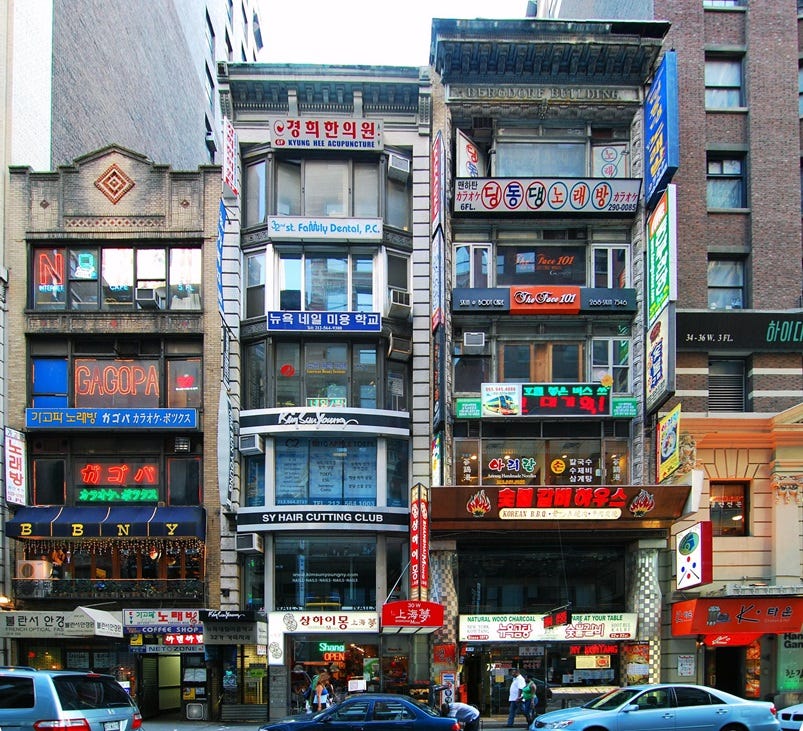
“Koreatown Manhattan 2009” by chensiyuan, CC BY‑SA 4.0. Grabbed from Noah Smith.
In Japan, someone can even build a tiny coffeeshop in front of their home【example】(https://substack.com/home/post/p-166181413).
Because of these small setups, many Japanese restaurants have only one or two staff. Some are physically so small they seat only two to five people; others have patrons standing up【example】(https://livejapan.com/en/in-tokyo/in-pref-tokyo/in-ueno/article-a0002702/).
A tiny restaurant staffed by a single person, a stove, and a rice cooker can sell lunch for roughly the same price you’d pay to cook at home. The overhead is minimal.
But in the U.S. tiny restaurants are illegal
Zoning requirements
Our zoning laws typically force almost every food‑service business to:
- Maintain a large building footprint
- Provide 2–4 parking spaces per business【source】(https://www.strongtowns.org/journal/2024/1/30/a-slow-and-steady-but-bittersweet-victory-against-arcane-parking-mandates)
- Operate at a scale that requires multiple employees
Food trucks could help if they were allowed at scale, but the restaurant industry fights to limit them. On average, a food truck must navigate 45 separate regulatory procedures and spend $28,276 in fees【source】(https://manhattan.institute/article/d-c-s-burdensome-food-truck-regulations).
Health‑code barriers
Most jurisdictions require 3–4 different sinks (a three‑part dish‑washing sink, a hand‑washing sink, a mop sink, and often a separate prep sink). This makes commercial kitchens under 200 sq ft extremely difficult to certify.
The U.S. food‑regulation system is fragmented:
- ~3,000 agencies handle food regulations【source】(https://www.fda.gov/food/guidance-regulation-food-and-dietary-supplements/retail-food-protection)
- The rules are scattered across eight places in municipal codes【source】(https://x.com/KelseyTuoc/status/1902806006306062405) and vary widely by location
When every restaurant is forced to be big, expensive, and car‑dependent, cheap daily food becomes harder to obtain.
Density drives prices down
Singapore’s hawker centers serve $3 meals【source】(https://eatbook.sg/cheap-3-dollar-dishes/). Hong Kong offers $4 lunch boxes【source】(https://www.nytimes.com/2022/05/02/world/asia/hong-kong-inexpensive-dining.html). Even Manhattan has 99‑cent pizza slices【source】(https://www.bloomberg.com/news/articles/2023-01-12/how-inflation-devoured-nyc-s-last-great-bargain-cheap-pizza#:~:text=From%202014%20to,by%20Quigley%E2%80%99s%20calculation).
These models rely on tiny storefronts that maximize foot‑traffic volume. Dense neighborhoods provide a constant stream of customers, allowing restaurants to profit from high sales volume rather than high prices.
Japanese cities let restaurants cluster in mixed‑use buildings where people live, work, and transit. A 20‑seat ramen shop near a station can see hundreds of potential customers during the lunch rush.
In contrast, American zoning typically separates commercial and residential uses. Outside of New York City, most U.S. restaurants depend on destination trips by car, creating friction that reduces total foot traffic and forces higher prices.
Higher Prices to Stay Profitable
Zoning and City Design Doesn’t Just Impact Housing Supply
Half of Americans spend nearly an hour a day cooking, partly because there’s no sub‑$4 option. A lot of us hate cooking but don’t want to spend $11 at Chipotle.
This category of restaurant is a form of basic infrastructure in Singapore, Hong Kong, and Japan.
When regulations prevent everyday people from starting businesses on small lots, we don’t just lose those businesses—we lose the price points they make possible.
Individual regulations, each reasonable in isolation, can combine to lock out exactly the small‑scale solutions that would help working families most. We can rewrite the rules to enable the neighborhood businesses that working families actually need.