
Agent Factory Recap: A Deep Dive into Agent Evaluation, Practical Tooling, and Multi-Agent Systems
Source: Dev.to
Deconstructing Agent Evaluation
Beyond Unit Tests: Why Agent Evaluation Is Different
Timestamp: 02:20
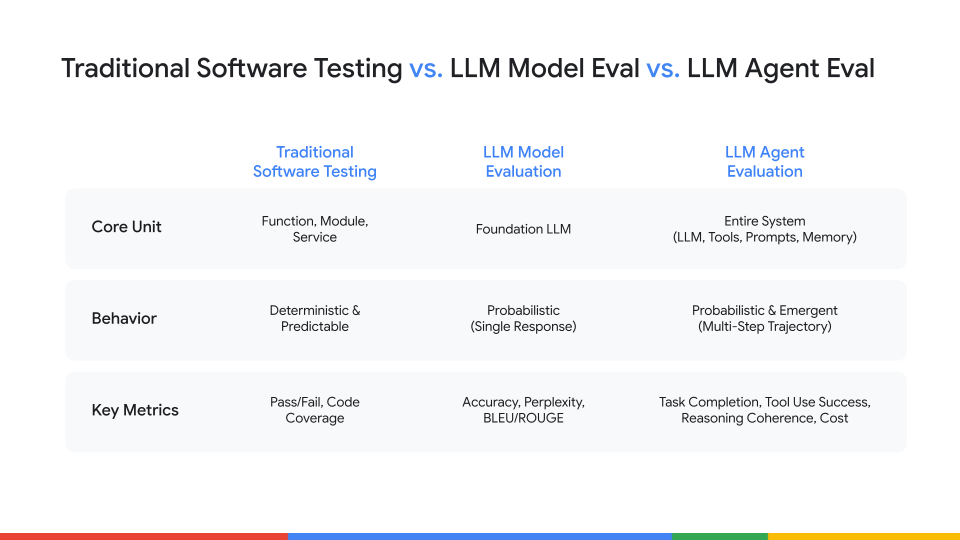
Evaluating an agent differs fundamentally from traditional software testing.
- Traditional software tests are deterministic; the same input always produces the same output (A = B).
- LLM evaluation resembles a school exam: static knowledge is probed with Q&A pairs to see if the model “knows” something.
- Agent evaluation is more like a job performance review. We assess a complex system’s behavior—including autonomy, reasoning, tool use, and handling of unpredictable situations. Because agents are non‑deterministic, the same prompt can yield different—but equally valid—outcomes.
A Full‑Stack Approach: What to Measure
Timestamp: 04:15
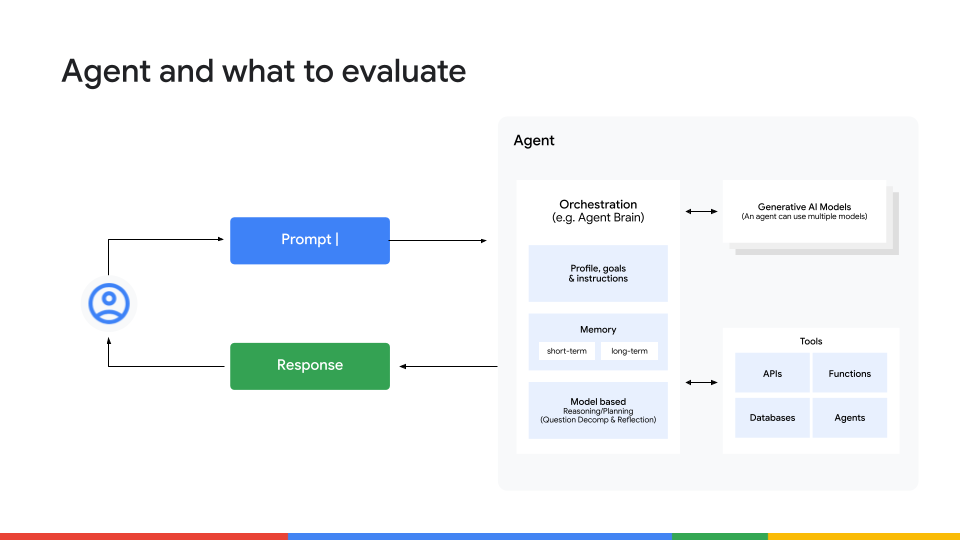
If we’re not just looking at the final output, what should we be measuring? The short answer is everything. We need a full‑stack approach that examines four key layers of the agent’s behavior:
-
Final Outcome – Did the agent achieve its goal?
Beyond a simple pass/fail, consider quality, coherence, accuracy, safety, and hallucination avoidance. -
Chain of Thought (Reasoning) – How did the agent arrive at its answer?
Verify that it broke the task into logical steps and that its reasoning is consistent. An agent that gets the right answer by luck isn’t reliable. -
Tool Utilization – Did the agent pick the right tool and pass the correct parameters?
Assess efficiency and watch for costly, redundant API‑call loops. -
Memory & Context Retention – Can the agent recall information from earlier in the conversation when needed?
If new information conflicts with existing knowledge, can it resolve the conflict correctly?
How to Measure: Ground Truth, LLM‑as‑a‑Judge, and Human‑in‑the‑Loop
Timestamp: 06:43
Once you know what to measure, the next question is how. Below are three popular methods, each with its own pros and cons:
| Method | Strengths | Limitations |
|---|---|---|
| Ground‑Truth Checks | • Fast, cheap • Reliable for objective measures (e.g., “Is this a valid JSON?” or “Does the format match the schema?”) | • Cannot capture nuance or subjective quality |
| LLM‑as‑a‑Judge | • Scales well • Can score subjective qualities like plan coherence | • Judgments inherit the model’s training biases and may be inconsistent |
| Human‑in‑the‑Loop | • Gold‑standard accuracy • Captures nuance and domain expertise | • Slow and expensive |
Key Takeaway
Don’t rely on a single method. Combine them in a calibration loop:
- Create a golden dataset – have human experts produce a small, high‑quality set of annotated examples.
- Fine‑tune an LLM‑as‑a‑judge on that dataset until its scores align with the human reviewers.
- Deploy the calibrated judge for large‑scale automated evaluation.
This approach gives you human‑level accuracy at an automated scale.
The Factory Floor: Evaluating an Agent in 5 Steps
The Factory Floor segment moves from high‑level concepts to a practical demo using the Agent Development Kit (ADK).
Hands‑On: A 5‑Step Agent Evaluation Loop with ADK
Timestamp: 08:41
The ADK Web UI is perfect for fast, interactive testing during development. Below is the five‑step “inner loop” workflow we used to debug a simple product‑research agent that was using the wrong tool.
-
Test and Define the “Golden Path.”
- Prompt:
Tell me about the A‑phones. - The agent returned the wrong information (an internal SKU instead of a customer description).
- We corrected the response in the Eval tab to create our first “golden” test case.

- Prompt:
-
Run the Agent Against the Golden Test.
- Execute the test in the Run tab.
- Verify that the output now matches the expected description.
-
Add Edge‑Case Tests.
- Introduce variations of the prompt (e.g., different product names, ambiguous queries).
- Record the expected outcomes in the Eval tab.
-
Iterate on Prompt / Tool Selection.
- Adjust the agent’s prompt or tool‑selection logic based on failures.
- Re‑run the full test suite to ensure regressions are caught.
-
Automate the Loop.
- Export the test suite to a CI pipeline.
- Use ADK’s CLI to run the evaluation automatically on each commit.
Evaluation Workflow (with Screenshots)
-
Evaluate and Identify Failure
With the test case saved, we ran the evaluation. As expected, it failed immediately.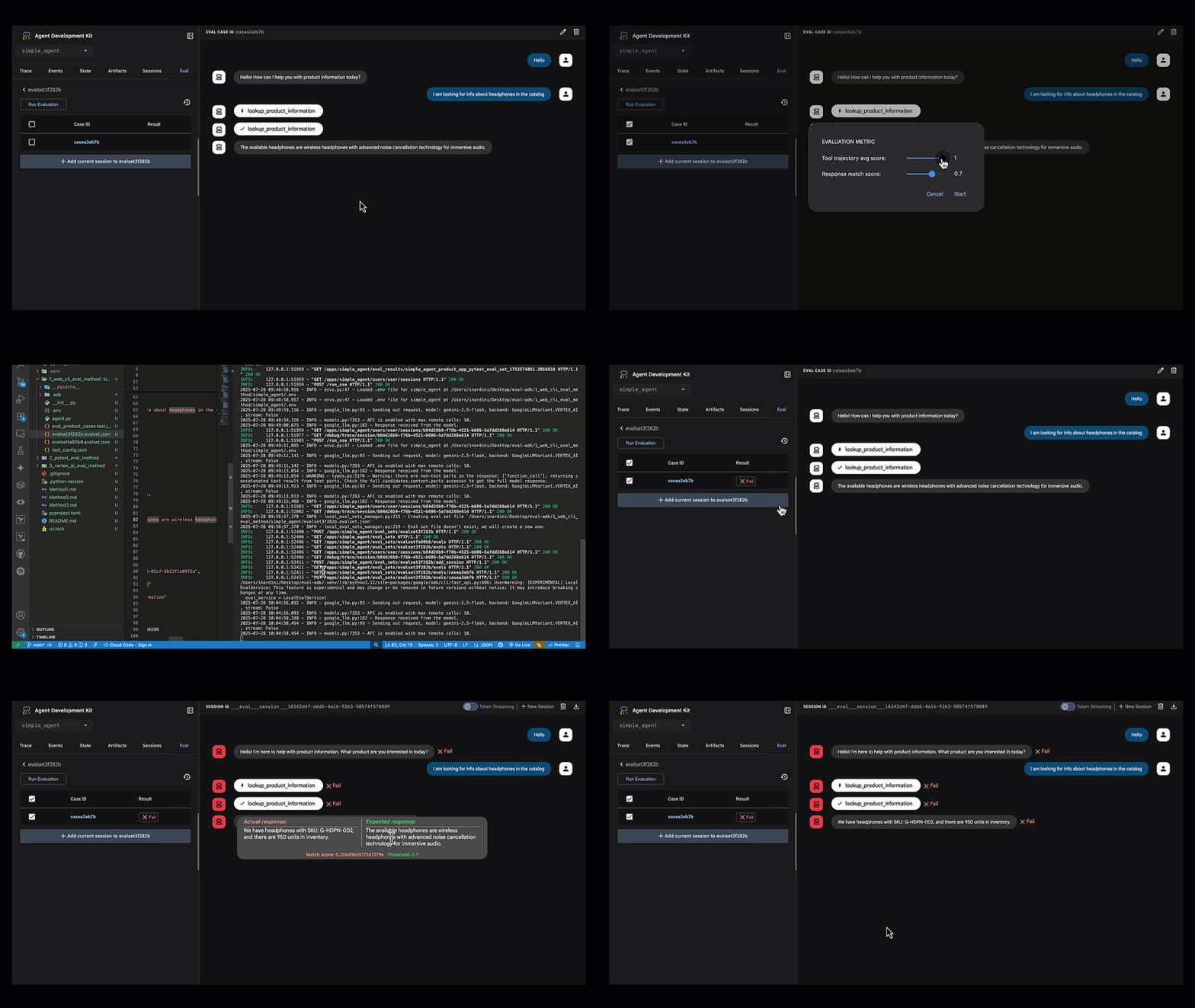
-
Find the Root Cause
We opened the Trace view, which shows the agent’s step‑by‑step reasoning process. It instantly became clear that the agent chose the wrong tool (lookup_product_informationinstead ofget_product_details).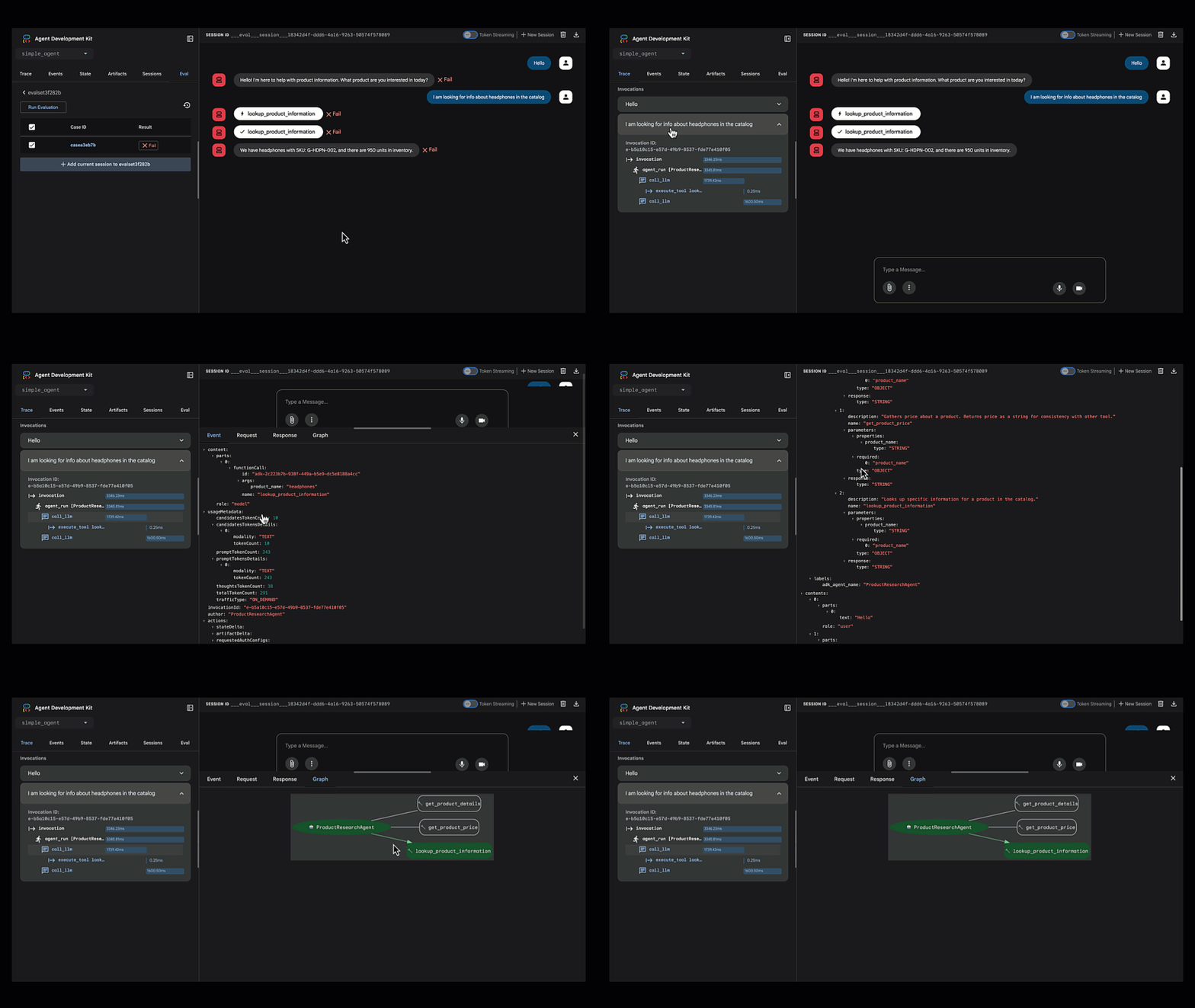
-
Fix the Agent
The root cause was an ambiguous instruction. We updated the agent’s code to be explicit about which tool to use for customer‑facing requests versus internal data. -
Validate the Fix
After the ADK server hot‑reloaded our code, we re‑ran the evaluation. This time the test passed and the agent returned the correct customer‑facing description.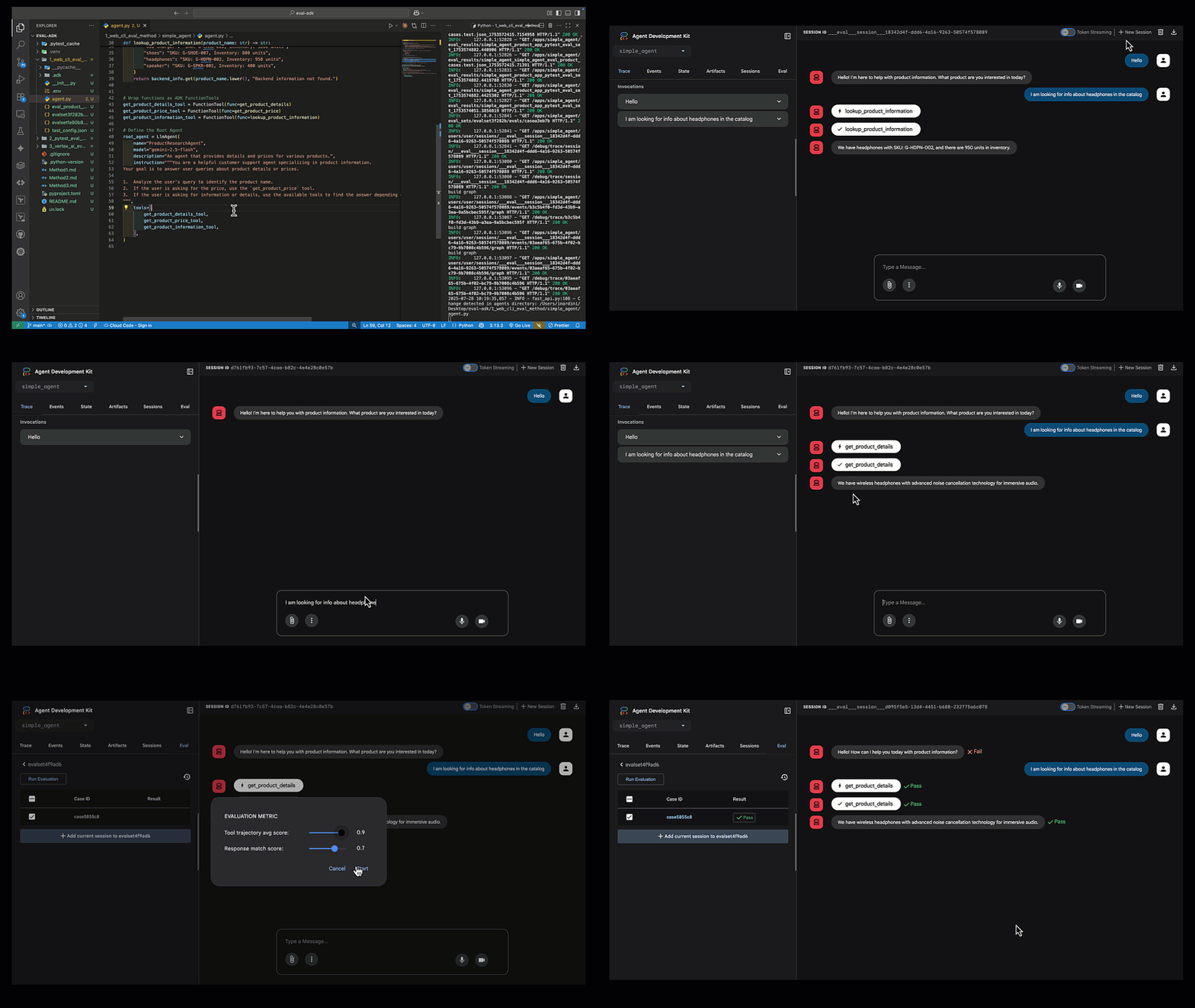
From Development to Production
The ADK workflow is fantastic for development, but it doesn’t scale. For production‑grade needs, move to a platform that can handle large‑scale evaluations.
From the Inner Loop to the Outer Loop: ADK and Vertex AI
Timestamp: 11:51
- ADK for the Inner Loop – fast, manual, interactive debugging during development.
- Vertex AI for the Outer Loop – run evaluations at scale with richer metrics (e.g., LLM‑as‑a‑judge). Use Vertex AI Gen AI evaluation services to handle complex, qualitative evaluations and build monitoring dashboards.
The Cold‑Start Problem: Generating Synthetic Data
Timestamp: 13:03
When you don’t have a real dataset, you can create synthetic data using a simple four‑step recipe:
| Step | Description |
|---|---|
| 1️⃣ Generate Tasks | Prompt a large language model (LLM) to produce realistic user tasks. |
| 2️⃣ Create Perfect Solutions | Use an “expert” agent to write an ideal, step‑by‑step solution for each task. |
| 3️⃣ Generate Imperfect Attempts | Let a weaker or different agent attempt the same tasks, producing flawed outputs. |
| 4️⃣ Score Automatically | Deploy an LLM‑as‑a‑judge to compare the imperfect attempts with the perfect solutions and assign scores. |
The Three‑Tier Framework for Agent Testing
Timestamp: 14:10
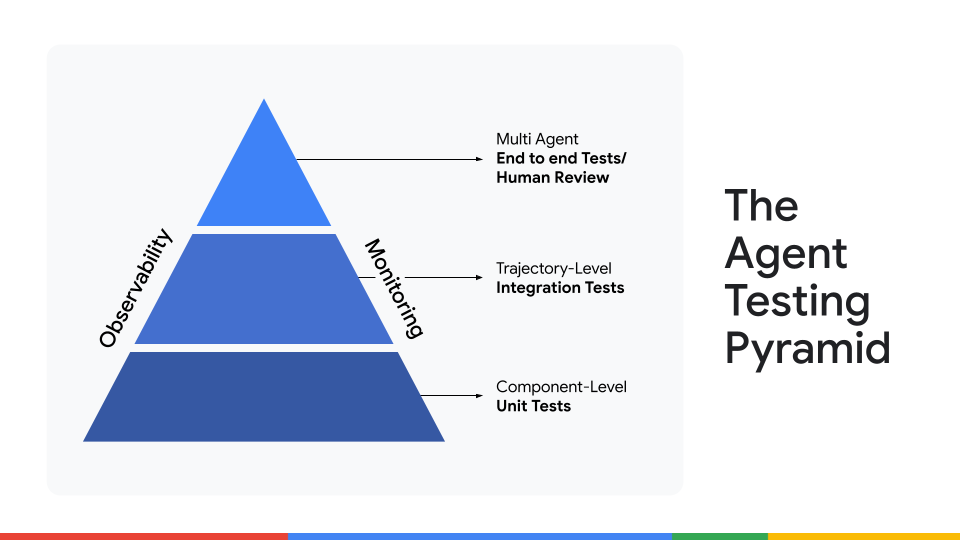
When you have evaluation data, design tests that scale using three tiers:
| Tier | Purpose | Example |
|---|---|---|
| 1️⃣ Unit Tests | Test the smallest pieces in isolation. | Verify that fetch_product_price extracts the correct price from a sample input. |
| 2️⃣ Integration Tests | Evaluate the full, multi‑step journey for a single agent. | Give the agent a complete task and check that it correctly chains reasoning and tools to produce the expected outcome. |
| 3️⃣ End‑to‑End Human Review | Human experts assess final outputs for quality, nuance, and correctness. | Use a “human‑in‑the‑loop” feedback system to continuously calibrate the agent, and test interactions among multiple agents. |
The Next Frontier: Evaluating Multi‑Agent Systems
Timestamp: 15:09
As we move from single‑agent pipelines to orchestrations of many agents, evaluation must also evolve. Future work includes:
- Defining system‑level metrics (e.g., coordination efficiency, conflict resolution).
- Building automated orchestration test harnesses that can simulate complex user journeys across multiple agents.
- Extending LLM‑as‑a‑judge frameworks to assess collaborative outcomes, not just individual responses.
Evaluating Multi‑Agent Systems
Judging an agent in isolation doesn’t tell you much about the overall system’s performance.
We used an example of a customer‑support system with two agents:
- Agent A – handles the initial contact and gathers the necessary information.
- Agent B – processes refunds.
If a customer asks for a refund, Agent A’s job is to collect the info and hand it off to Agent B.
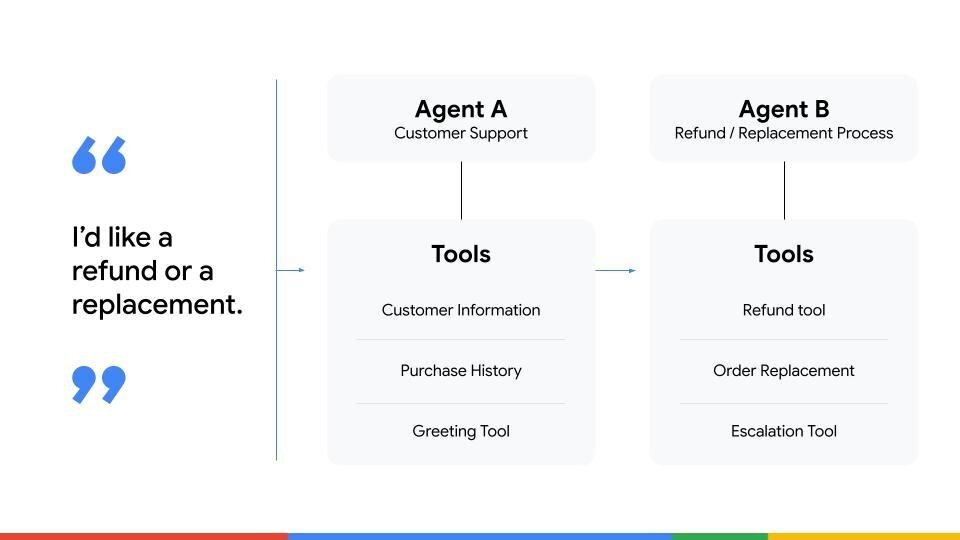
- Evaluating Agent A alone might give it a task‑completion score of 0 because it never issues the refund.
- In reality, it performed its job perfectly by successfully handing off the task.
- Conversely, if Agent A passes the wrong information, the whole system fails—even if Agent B’s logic is flawless.
This illustrates why, in multi‑agent systems, end‑to‑end evaluation matters most. We need to measure how smoothly agents hand off tasks, share context, and collaborate to achieve the final goal.
Open Questions and Future Challenges
Timestamp: 18:06
We wrapped up by touching on some of the biggest open challenges in agent evaluation today:
- Cost‑Scalability Trade‑off – Human evaluation is high‑quality but expensive; LLM‑as‑a‑judge is scalable but requires careful calibration. Finding the right balance is key.
- Benchmark Integrity – As models become more powerful, benchmark questions may leak into training data, making scores less meaningful.
- Evaluating Subjective Attributes – How can we objectively measure qualities such as creativity, proactivity, or humor in an agent’s output? This remains an open question for the community.
Your Turn to Build
This episode was packed with concepts, but the goal was to give you a practical framework for thinking about and implementing a robust evaluation strategy. From the fast, iterative loop in the ADK to scaled‑up pipelines in Vertex AI, having the right evaluation mindset is what turns a cool prototype into a production‑ready agent.
We encourage you to watch the full episode to see the demos in action and start applying these principles to your own projects.