
A Perfect Match for Big Data: VMware vSphere Kubernetes Service and Tanzu Greenplum
Source: VMware Blog
Enterprise Analytics: The New Era of Speed, Simplicity, and Resilience
For years, organizations have been forced to choose between the massive processing power of traditional data warehouses and the agile, “fail‑fast” nature of cloud‑native development. You either had the stability of a heavyweight database or the speed of Kubernetes—rarely both at the same time.
Our latest jointly validated solution on VMware vSphere Kubernetes Service (VKS) with Tanzu Greenplum shows that compromise is officially a thing of the past. By bringing Greenplum’s massively parallel processing (MPP) engine into VMware Cloud Foundation (VCF)—with an in‑built CNCF‑certified Kubernetes runtime—businesses are discovering a “better together” powerhouse.
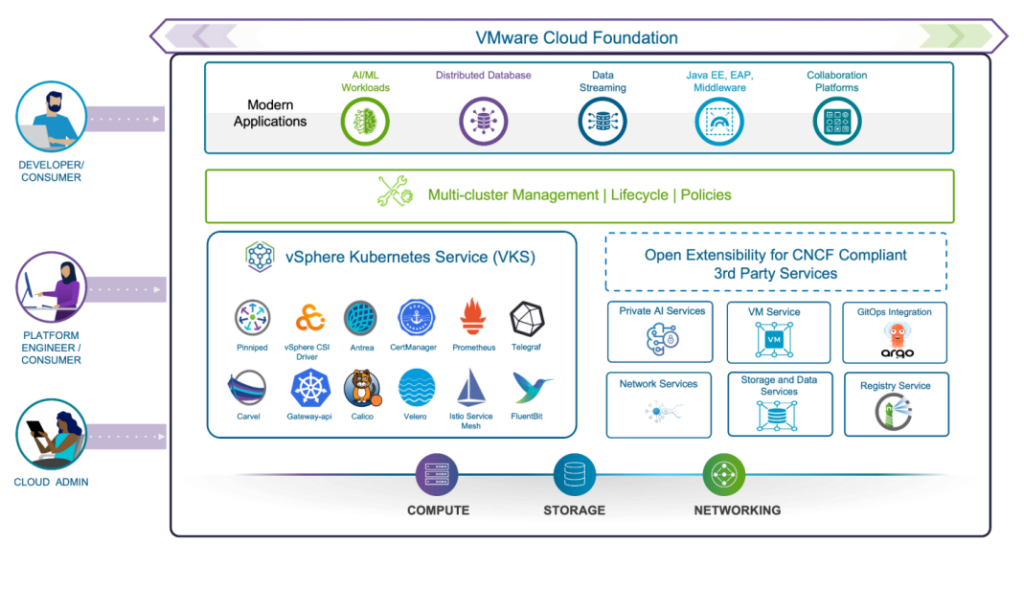
Figure: VKS on VCF ecosystem
Why This Combination Is Changing the Game for Data‑Driven Enterprises
1. Speed to Value – From Weeks to Minutes
- The Greenplum Operator on VKS automates container provisioning, complex networking, and dependency management.
- Think of the Operator as a “digital DBA” that knows exactly how Greenplum should be deployed.
- Whether you need a small PoC or a 100‑node production cluster, the turnaround time is now measured in minutes, enabling rapid experimentation and faster customer onboarding.
2. Operational Simplicity (Finally!)
- Tool sprawl ends when VKS is built directly into VCF, using the VMware tools your team already knows.
- VKS runs containers at the same level as virtual machines, giving Cloud Admins a unified view of the entire fleet.
- Policies, security controls, and management workflows stay consistent across VMs and containers—no massive retraining required.
3. Dedicated Performance with “Workload Zones”
- VCF 9.0 lets admins define Workload Zones that carve out dedicated infrastructure optimized for Greenplum’s MPP architecture.
- Resources are isolated from other applications, eliminating the “noisy neighbor” effect while still benefiting from shared‑infrastructure efficiency.
4. Enterprise‑Grade Resiliency – The “Self‑Healing” Database
- Greenplum on VKS runs as StatefulSets, so Kubernetes handles failure detection and recovery automatically.
- If a pod crashes or a node fails, the Greenplum Operator spins up a replacement pod and re‑attaches the existing Persistent Volumes (PVs).
- The cluster restores itself without manual DBA intervention—no 3 a.m. wake‑ups required.
5. Secure Air‑Gap Deployments
- Integration with VMware NSX enables highly regulated, air‑gapped environments.
- Kubernetes Namespaces and Role‑Based Access Control (RBAC) limit the blast radius of any security incident, keeping sensitive data exactly where it belongs.
6. Optimized Resource Consumption & Lower TCO
- Greenplum on VKS supports granular, independent scaling of compute and storage, eliminating “over‑provisioning.”
- Sharing the underlying infrastructure with other Kubernetes services reduces hardware requirements, driving down Total Cost of Ownership (TCO) and the environmental footprint.
Bottom line: By uniting Greenplum’s MPP engine with VMware’s VKS on VCF, enterprises finally get the best of both worlds—massive analytical horsepower and cloud‑native agility—without sacrificing stability, security, or cost efficiency.
TL;DR
The combination of VMware vSphere Kubernetes Service (VKS) and Tanzu Greenplum represents the next evolution of the data platform. It pairs the “brute‑force” analytical power of a world‑class MPP database with the “smart” automation of a modern, CNCF‑certified Kubernetes runtime.
- Business benefit: Faster insights and lower costs.
- IT benefit: Simplified operations and enterprise‑grade security.
It’s a rare win‑win in enterprise tech—proving that, for big data, we really are better together.
Want the technical details?
Read the full Reference Architecture to start building your own high‑performance analytics environment today.