
A Different Way to Build: My Experience with Kiro + IncidentOps
Source: Dev.to
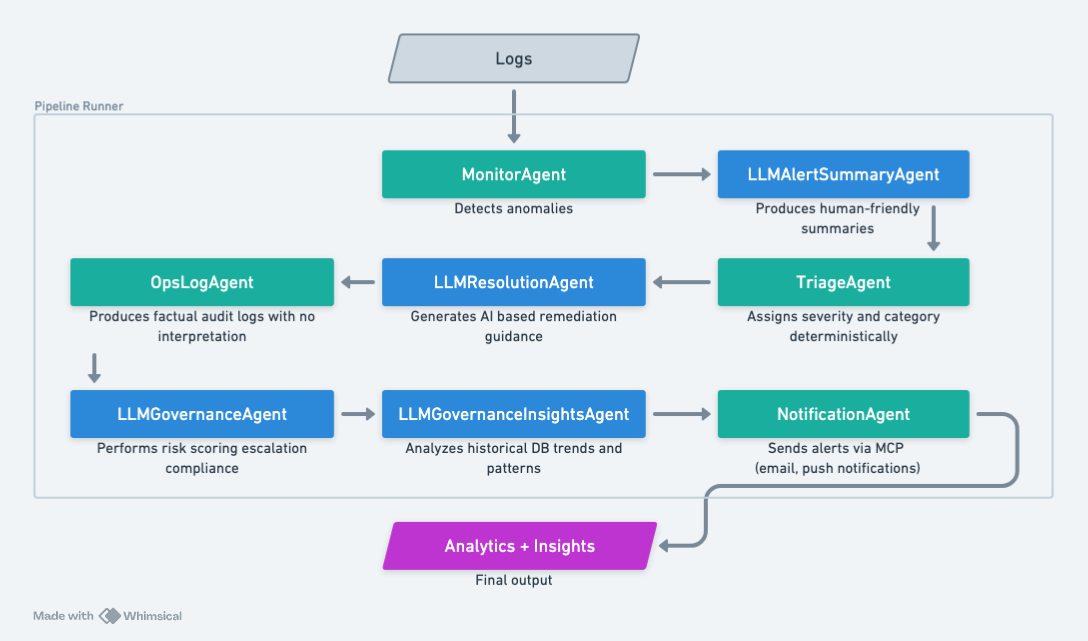
Architecture Overview
Why Kiro?
What surprised me most about this project was how different Kiro felt from typical AI‑assisted coding. Instead of trying to “guess” what I wanted, Kiro encouraged me to define the system clearly through spec‑driven development.
Writing the specs felt natural — almost like capturing my thought process. Once the specs were ready, the Start Task workflow made execution predictable and efficient. I could ask Kiro to build one component at a time, review it, refine it, and move forward.
Tasks that normally take weeks across engineering and operations teams were completed in hours with human review.
What I Built
IncidentOps is a sequential pipeline:
MonitorAgent → LLMAlertSummaryAgent → TriageAgent →
LLMResolutionAgent → OpsLogAgent → LLMGovernanceAgent →
LLMGovernanceInsightsAgent → NotificationAgent
Agent responsibilities
- Detect anomalies
- Produce human‑friendly summaries
- Assign severity and category deterministically
- Suggest remediation steps
- Write factual audit logs (no interpretation)
- Score risk, escalation, and compliance
- Analyze historical patterns using DB aggregations
- Send notifications
Technologies used
- Python for orchestration
- SQLite for persistence
- Streamlit for the UI
- LLMs for summarization, remediation, and insights
- Kiro’s spec‑driven workflow for structure and iteration
What I Learned
- Clear specs dramatically speed up development.
- AI‑generated code still requires human validation.
- Small, well‑defined units reduce complexity and drift.
- Combining deterministic logic with LLM reasoning gives both reliability and adaptability.
- A structured workflow makes even complex systems manageable under tight timelines.
Closing Thoughts
Good tools don’t just accelerate development — they improve clarity of thought. For incident management, where hidden patterns matter as much as visible errors, that clarity is essential.
Thanks to the Kiro team for a workflow that felt steady, transparent, and surprisingly enjoyable. I’m excited to continue refining IncidentOps beyond the hackathon.