
5 key takeaways from the 2026 State of Software Delivery
Source: CircleCI Blog
AI has made it easier than ever to write code. Shipping it is a different story.
Today we released the 2026 State of Software Delivery report, sponsored by Thoughtworks. In it, we analyzed more than 28 million CI/CD workflows across thousands of engineering teams. The picture that emerged is clear: teams are producing more code than ever, but fewer of them are able to turn that activity into software that actually reaches customers.
Break the AI bottleneck
Here are the five findings that matter most:
- [Finding 1] – Brief description of the first key insight.
- [Finding 2] – Brief description of the second key insight.
- [Finding 3] – Brief description of the third key insight.
- [Finding 4] – Brief description of the fourth key insight.
- [Finding 5] – Brief description of the fifth key insight.
(Replace the placeholder titles and descriptions with the actual findings from the report.)
1. Average Throughput Jumped 59 %, but Almost All of It Went to the Top
Across all projects building on CircleCI, the average number of daily workflow runs increased 59 % year‑over‑year, the biggest throughput increase we’ve ever seen. AI‑powered code generation and agent‑driven workflows are clearly helping teams produce more changes, faster.
But that number is misleading on its own.
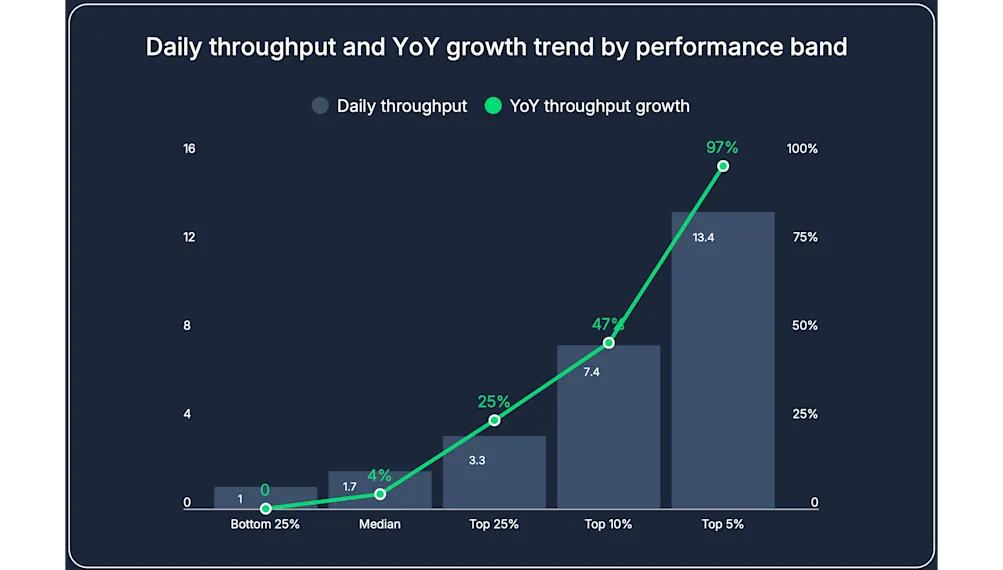
- Top 5 % of teams: nearly doubled their throughput, with daily workflow runs up 97 %.
- Median team: up only 4 %.
- Bottom quartile: no measurable increase.
AI is amplifying existing delivery strengths rather than distributing them evenly. Teams that already had strong pipelines and validation practices are pulling further ahead, while everyone else is working harder just to stay in place.
Read more about AI as a DORA amplifier →
2. Teams Can Write Faster, but They Can’t Ship Faster
Here’s the most telling split in the data: most teams saw a clear increase in activity on feature branches, where AI helps with prototyping and iteration. But throughput on the main branch, where code actually gets promoted to production, declined. For the median team, feature‑branch throughput increased 15 %, while main‑branch throughput fell by 7 %.
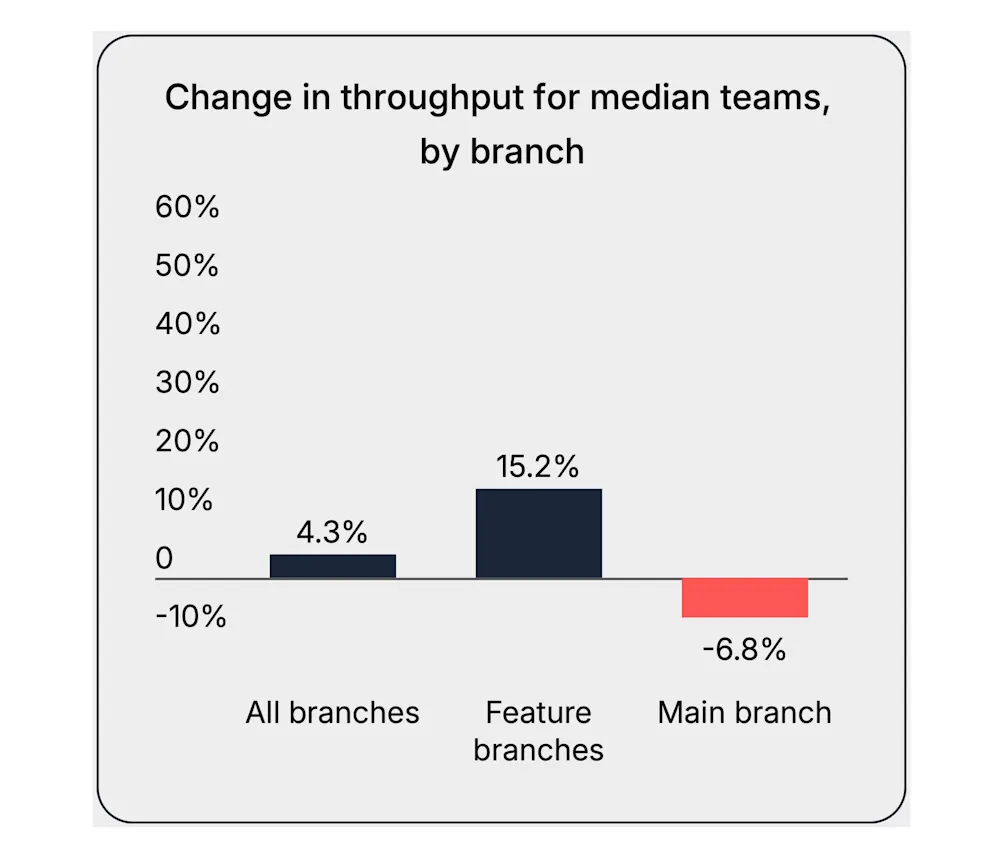
Even teams in the top 10 % struggled. Feature‑branch activity grew almost 50 % for that group, while main‑branch throughput increased only 1 %.
This is concrete evidence of the AI delivery bottleneck we’ve been calling out since last year. Writing code is no longer the constraint—review, validation, integration, and recovery are. That’s where AI‑generated code is piling up, quietly draining velocity, morale, and ROI from every AI investment.
3. AI‑generated code breaks more often and takes longer to fix
Main branch success rates have fallen to 70.8 %, the lowest in over five years and well below CircleCI’s recommended benchmark of 90 %. That means nearly 3 out of every 10 attempts to merge into production are failing.
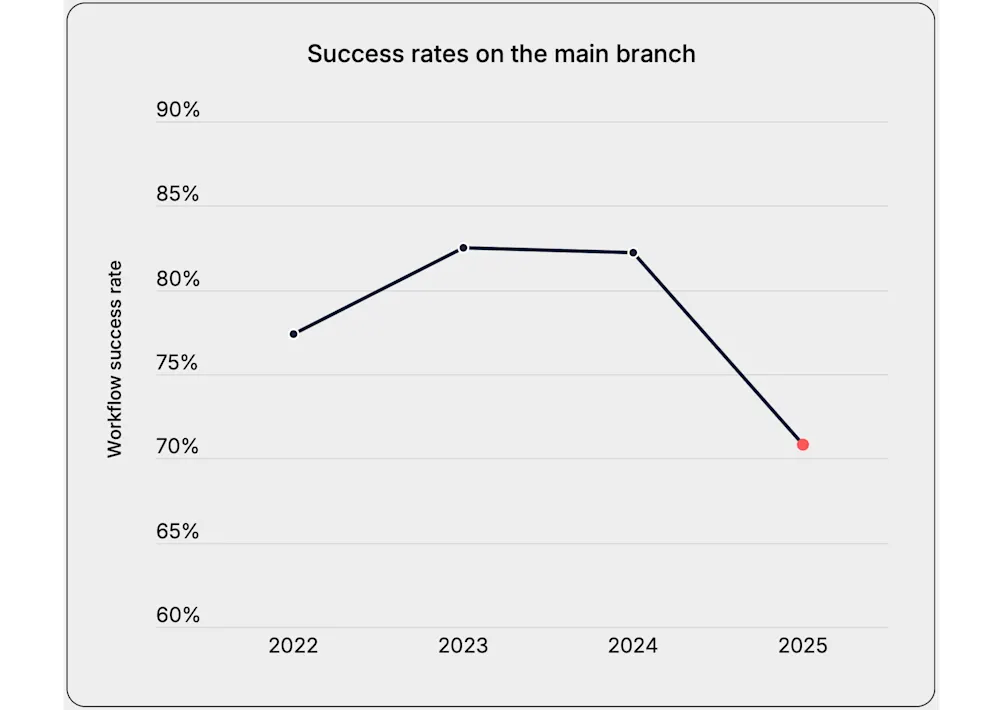
Recovery times are climbing too: the typical team now needs 72 minutes to get back to green, 13 % higher than last year.
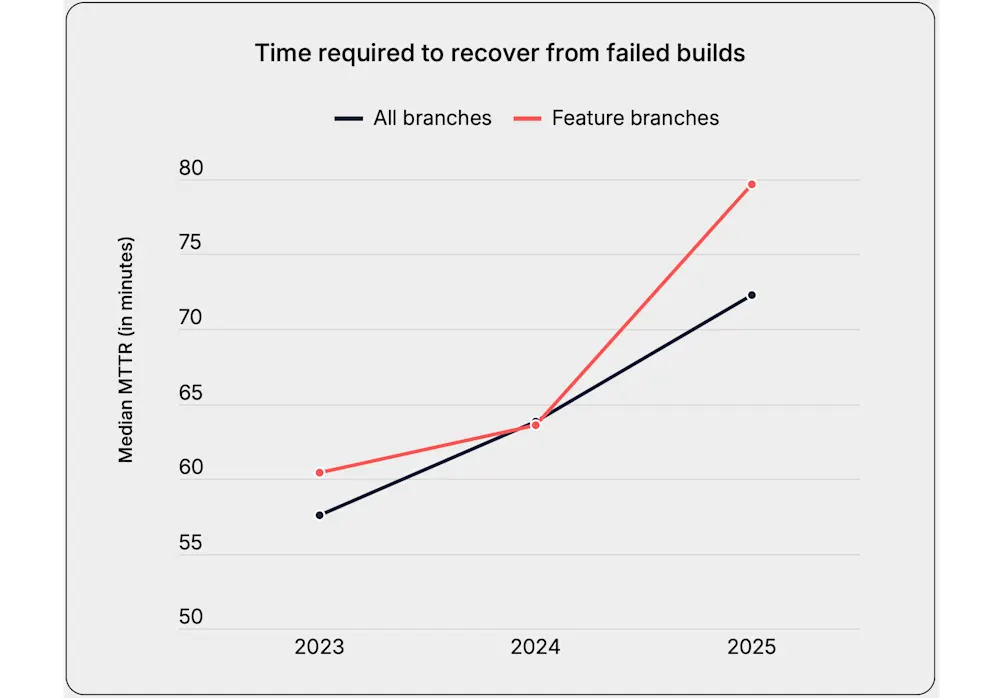
What the numbers mean
- A team pushing 5 changes per day at a 70 % success rate experiences ≈1.5 show‑stopping failures each day.
- At the 90 % benchmark, the same team would see ≈0.5 failures every two days.
- Even if the team met the benchmark recovery time of 60 minutes (12 minutes faster than the 2026 median), the gap translates to roughly 250 extra hours of debugging and blocked deployments per year.
Scaling the impact
- 500 changes per day would consume the equivalent of ≈12 full‑time engineers just to restore green status.
These figures illustrate how AI‑generated code can increase both failure frequency and remediation effort, eroding productivity at scale.
4. Fewer than 1 in 20 teams have figured out how to ship at AI speed
The top 5 % of teams are the exception to every trend above. Their throughput grew 97 % year over year. Their main‑branch throughput increased 26 %, while feature‑branch activity grew 85 %. They’re writing more code and shipping more code.
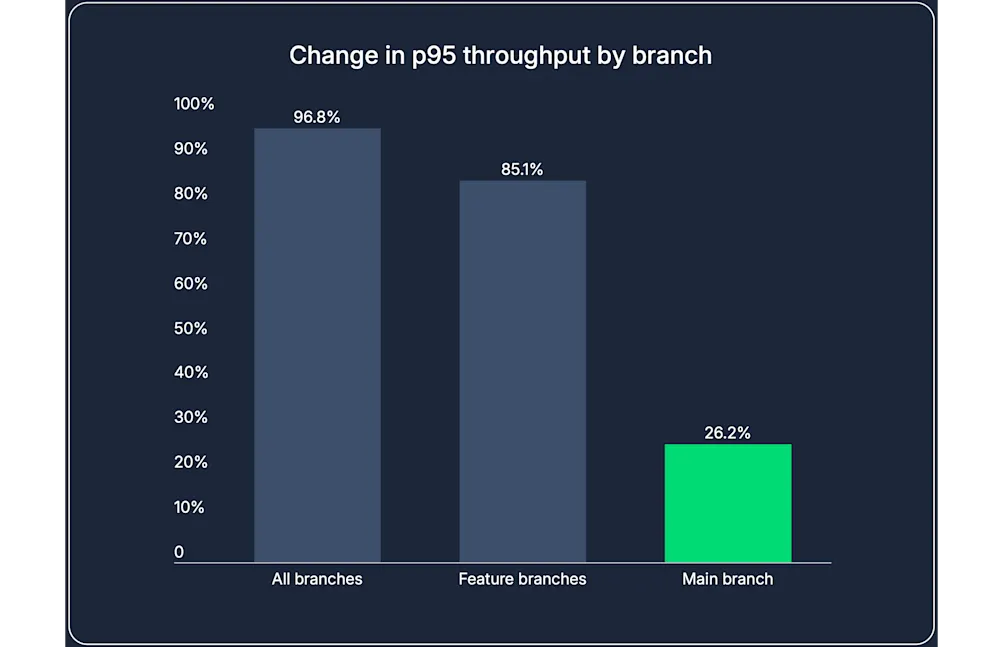
But they represent fewer than 1 in 20 teams. Their results show what’s possible when validation keeps pace with generation, and they also highlight how far most teams still have to go.
5. Mid‑sized Companies Are Stuck in the “Messy Middle”
Performance by company size follows a U‑shaped curve:
| Company Size | Throughput | Mean Time to Recovery (MTTR) |
|---|---|---|
| 2–5 employees (small) | Highest | Fastest |
| 21–50 employees (mid‑size) | Lowest | ≈ 3 hours (≈ 4× longer than the smallest and largest cohorts) |
| 1,000+ employees (large) | Highest | Fastest |
Mid‑sized firms (21–50 employees) struggle the most: they have the lowest throughput of any segment and recovery times approaching three hours—nearly four times longer than the smallest and largest cohorts.
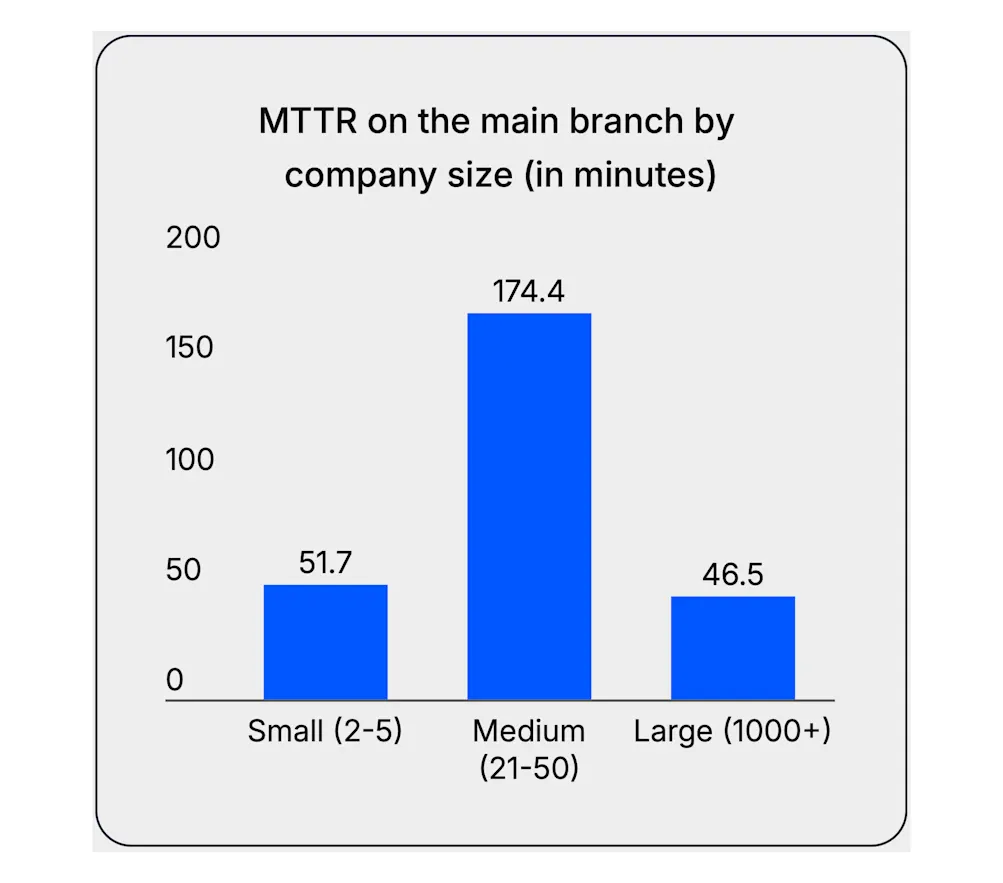
Interpretation
The pattern suggests a scaling problem. These companies have outgrown the speed and simplicity of small teams but haven’t yet built the systems and practices needed to operate at scale. AI is making this gap more visible and more costly.
How Can Your Team Close the Gap?
The data points to a clear conclusion: success in the AI era isn’t determined by how fast code gets written. It’s determined by how fast it can be validated, integrated, and recovered.
The teams pulling ahead have invested in:
- Faster feedback loops
- Smarter test selection
- Pipeline infrastructure that adapts to rising volume and complexity
The teams falling behind are running AI‑generated code through the same static pipelines they built for human‑speed development.
Autonomous Validation
This is the problem that autonomous validation is designed to solve. Instead of relying on static scripts and manual upkeep, autonomous validation brings context and intelligence into the CI/CD pipeline itself, allowing your validation layer to keep pace with the speed, scale, and complexity of AI‑driven code generation.
Learn More
Want to explore the dataset yourself? Visit the Software Delivery Data Explorer and compare your results against different team sizes, industries, and regions.
Based on 28,738,317 workflows run on CircleCI during September 2025 (projects with ≥ 2 contributors, workflows that ran ≥ 5 times). Full methodology in the complete report.