
10 Minutes to Reshape Your Go Development: 8 Tools to Reclaim Your Time
Source: Dev.to
The Go language itself is beautifully simple, but mastering its rich toolchain is the real secret to skyrocketing your development efficiency.
As a long‑time Go developer, I want to share a few tools that have been absolute game‑changers for me in terms of code‑quality control, infrastructure management, and environment setup.

1. GoVet – Stop Hunting Bugs Manually
I once had a project where, after deployment, the logic would occasionally jump out of loops inexplicably. During the post‑mortem, I realized a colleague had accidentally typed an assignment = instead of an equality check == inside an if statement. If we hadn’t reviewed the code line‑by‑line, we might never have found it.
GoVet is the official static‑analysis tool built right into Go. It doesn’t care about your code style; it focuses purely on runtime correctness, detecting potential logical errors and suspicious structures.
Run it on all packages from the project root:
go vet ./...GoVet catches a variety of common mistakes, such as unreachable code, mismatched Printf formatting strings and arguments, and improper use of mutexes.
package main

import "fmt"

func checkStatus() {
    status := 1
    // Mistakenly using an assignment statement in an if condition
    if status = 2; status > 0 {
        fmt.Println("Status is normal")
    }
}
When you run GoVet, it will warn about the assignment inside the if condition. Integrate this check into your CI pipeline or Git pre‑commit hooks to intercept low‑level bugs before they ever reach the repository.
2. Caddy – Modern Web Infrastructure
In the past, configuring Nginx for SaaS projects gave me anxiety—especially regarding SSL‑certificate expiration and reverse‑proxy setups. Maintaining hundreds of domain certificates manually is a nightmare.
Everything got simpler with Caddy. Written in Go, it is a web server and reverse proxy that handles HTTPS automatically. Once a domain resolves to your server, Caddy obtains and renews Let’s Encrypt certificates on its own. Its API is fantastic—you don’t even need to edit config files manually.
curl localhost:2019/config/apps/http/servers/srv0/routes \
  -X POST \
  -H "Content-Type: application/json" \
  -d '{
    "match": [{"host": ["api.new-service.com"]}],
    "handle": [{"handler": "reverse_proxy", "upstreams": [{"dial": "localhost:9000"}]}]
}'
Suddenly, managing proxies feels much more modern than wrestling with Nginx.
3. USQL – One CLI to Rule All Databases
Do you have a cluttered mess of database clients installed on your machine? Postgres, MySQL, SQLite… Switching between them eats up memory and breaks your focus.
USQL is a universal command‑line interface that supports PostgreSQL, MySQL, SQLite, and most mainstream databases, providing a unified operational syntax.
usql postgres://user:pass@localhost/db
usql sqlite://path/to/data.db
4. DBLab – Visual Control Without Leaving the Terminal
If reading raw data output in a pure CLI makes your eyes bleed, but you don’t want to open a heavy GUI client, use DBLab. It provides an interactive, terminal‑based UI.
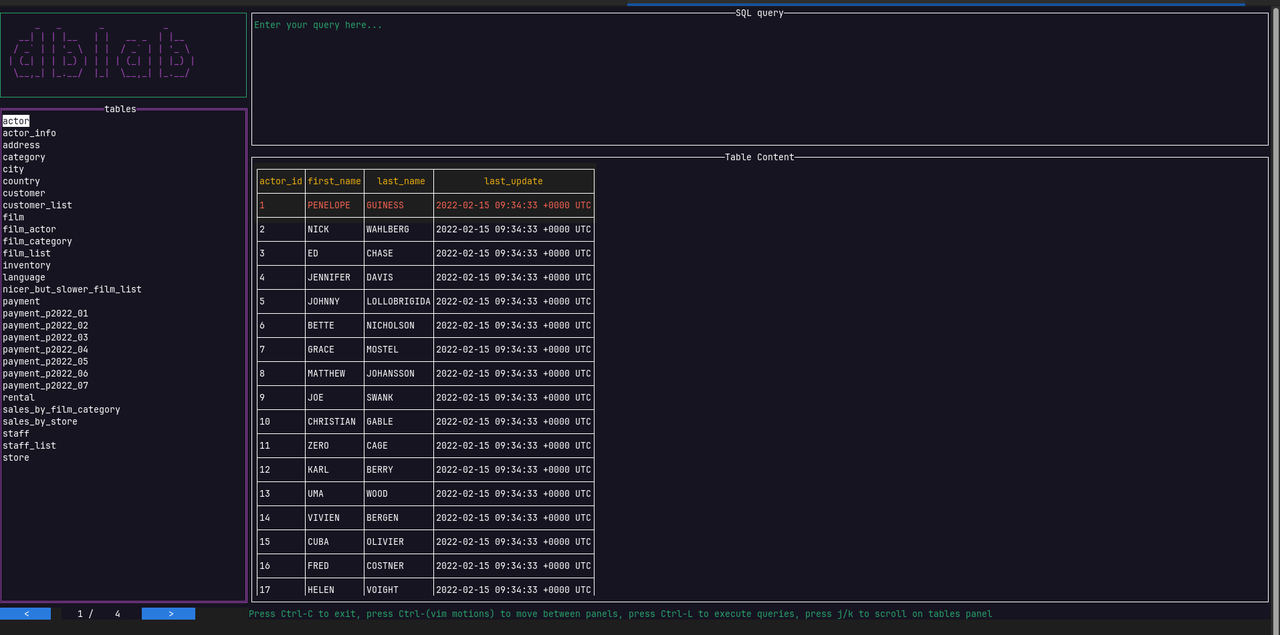
You can browse table data and filter results directly in your terminal. When validating temporary data in a development environment, tools that keep you close to your code editor massively improve focus.
5. Go Modules (GoMod) – Stop Losing Hair Over Dependencies
Let’s not talk about the dark ages of early Go dependency management (GOPATH). Today we have Go Modules—extremely convenient, but encountering a bug in a specific version of a library can still be awkward. What if a third‑party library has a bug and the official fix isn’t out yet?
The replace directive in go.mod shines here.
module my_app

go 1.21

require (
    github.com/pkg/errors v0.9.1
    github.com/example/lib v1.0.0
)

// Point the dependency to your local machine for debugging/hot‑fixing
replace github.com/example/lib => ../local_lib

// Explicitly exclude a known buggy version
exclude github.com/pkg/errors v0.9.0
6. Gopls – Supercharge Your Editor’s Intelligence
Gopls (pronounced “Go please”) is the official Language Server developed by the Go team. It provides:
- On‑the‑fly diagnostics and quick‑fix suggestions
- Auto‑completion, go‑to‑definition, and hover documentation
- Refactoring tools (rename, extract function, etc.)
Most modern editors (VS Code, GoLand, Vim/Neovim, Emacs) have built‑in support for gopls. Installing it is as simple as:
go install golang.org/x/tools/gopls@latestOnce enabled, you’ll notice a dramatic boost in productivity—errors are highlighted as you type, and you can navigate large codebases without ever leaving the editor.
TL;DR
| Tool | What it solves |
|---|---|
| GoVet | Detects logical bugs & misuse of language constructs |
| Caddy | Automatic HTTPS & modern reverse‑proxy configuration |
| USQL | Unified CLI for many databases |
| DBLab | Interactive, terminal‑based DB UI |
| Go Modules | Precise dependency version control (replace, exclude) |
| Gopls | IDE‑level intelligence for Go code |
Integrating these tools into your daily workflow will make Go development smoother, safer, and far more enjoyable. Happy coding!
Cleaned Markdown
e completion, jump‑to‑definition, and find‑references features for mainstream editors like VS Code and Vim.

When dealing with interface implementations, **gopls** lets you instantly find all structs that implement a specific method.

```go
type Storage interface {
    Save(data []byte) error
}

type FileStorage struct{}

func (f FileStorage) Save(data []byte) error {
    return nil
}
Install the latest language server easily:
go install golang.org/x/tools/gopls@latest7. Gosec: Automated Security Auditing
Security scanning is mandatory for commercial projects. Many developers have a bad habit of hard‑coding temporary tokens or casually using cryptographically insecure random number generators. Gosec will catch all of this in a single pass.
gosec ./...It scans your AST for security vulnerabilities like weak encryption algorithms or unhandled errors. Baking this tool into your CI pipeline will save your team from massive security‑auditing headaches down the line.
8. ServBay: Optimizing Your Go Environment Setup
Finally, the foundation that holds all this together. ServBay is an integrated development environment manager that provides the ability to install Go environment with one click.

You no longer need to write complex bash scripts to juggle environment variables. With a few clicks in its UI, you can assign entirely different Go runtime versions to different local projects.
Beyond just Go, ServBay natively integrates web servers like Caddy, alongside essential development databases and middleware such as MariaDB, PostgreSQL, and Redis. All services can be started or stopped with a single click. For developers who frequently switch between multiple Go versions or need to quickly simulate complex production environments locally, ServBay offers a clean and highly stable solution.
Conclusion
Stop doing manual labor disguised as programming. Mastering tools like GoVet, Caddy, and Go Modules will liberate you from tedious, mechanical tasks. Meanwhile, environment‑management tools like ServBay provide the solid foundation needed to integrate these tools seamlessly.
Give these a try—you will likely find that what you previously thought was a technical bottleneck was simply you using the wrong tool for the job.